

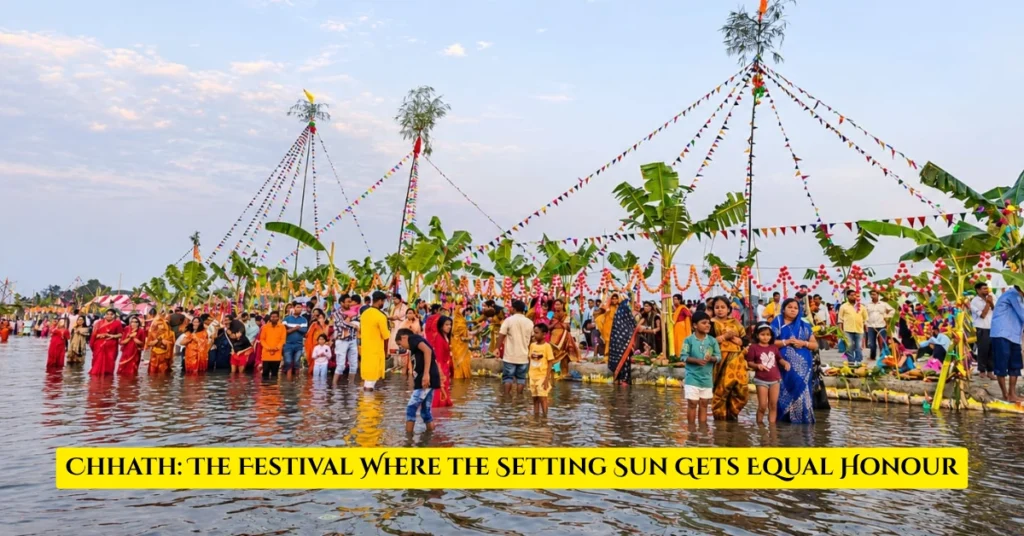
Most of the world worships the rising sun. Chhath Puja does something rarer: it bows to the sun at dusk, as the day ends and the light fades. That single choice reveals the philosophy behind one of India’s oldest and most demanding festivals.
A Festival Without Idols or Priests
Chhath has no temple, no idol and no priest. The devotee, called a vratin or parvaitin, speaks directly to Surya, the Sun God, and to Chhathi Maiya, a folk goddess regarded as protector of children. Everything happens at a river, pond, or any open water, making Chhath one of the most egalitarian rituals in Hindu practice. Caste, class and wealth fall away at the ghat, where a banker and a farmer stand knee-deep in the same water, holding the same bamboo baskets.
The Four-Day Discipline
The festival unfolds over four days after Diwali, and its rigour surprises first-time observers.
Nahay Khay begins with a ritual bath in a river and a simple meal of rice, bottle gourd and chana dal, cooked in a freshly cleaned kitchen.
Kharna is a full day of fasting without even water, broken at sunset with rasiao-kheer, a jaggery-and-rice pudding, and rotis.
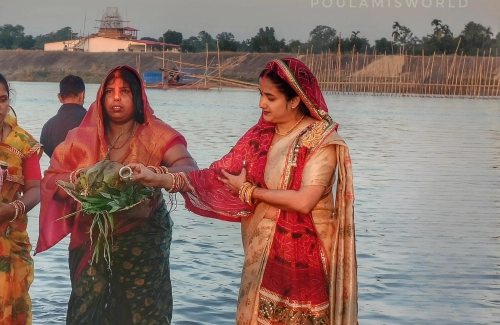
Sandhya Arghya is the evening offering. Devotees stand in water at sunset and offer arghya to the setting sun, with baskets of fruit, thekua and sugarcane.
Usha Arghya is the dawn offering. After a night of vigil, devotees return to the water to greet the rising sun, and only then break their roughly 36-hour waterless fast.
Why the Setting Sun?
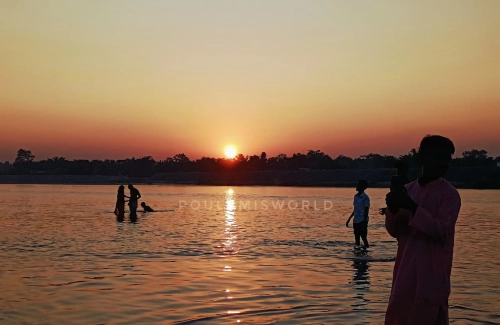
This part of Chhath gets the least attention. Honouring the sunset is a quiet teaching in gratitude: we thank the source of life not only when it promises a new day, but when it departs, having already given everything. Many families describe the evening arghya as the more emotional of the two, with the water turning gold, the oil lamps flickering and the folk songs rising together across the ghat.
Science Woven into Ritual
Whether you read it as spiritual or not, the practice has its own logic. Standing in water at sunrise and sunset exposes the body to gentler sunlight, and the long fast is followed by a deliberate, simple, sattvic meal. The festival also asks people to keep the environment clean. Ghats are swept, households maintain strict hygiene, and no artificial materials are used in the offerings. Bamboo baskets, earthen lamps, seasonal fruit and jaggery-based sweets mean the whole festival runs on natural, biodegradable materials.
The Songs That Carry the Festival
No account of Chhath is complete without its music. Shared Bhojpuri, Maithili and Magahi folk songs, passed down orally by women, form the festival’s emotional soundtrack. In many homes, they are sung without instruments, and they speak of a daughter asking for a child, a farmer’s gratitude, and a mother’s devotion. The songs matter because they preserve a women-led tradition, one where grandmothers teach daughters not just the rules, but the melodies of faith.
A Festival That Travelled
Chhath began in Bihar, eastern Uttar Pradesh and Nepal’s Terai region. But migration has carried it far beyond its birthplace, across India and the world.
Today, devotees gather at the Hooghly ghats in Kolkata, the Yamuna in Delhi and Mumbai’s Juhu beach. You will even find them on riverbanks in Mauritius, Fiji, the Caribbean and the United States.
Wherever the diaspora settles, it seeks out water and sets up the baskets. That says a lot about how deeply the ritual is rooted in identity.
The Women at the Centre
Although men can observe the fast, women overwhelmingly carry Chhath, taking on its physical demands with remarkable stamina and often passing the vow from mother to daughter or daughter-in-law. In many families, once a woman takes up the vrat, she observes it for life, and abandoning it is considered inauspicious. That discipline, unseen and unglamorous, is the festival’s real engine.
What Chhath Teaches Us
Chhath asks for very little that money can buy. It asks for cleanliness, patience, humility and the willingness to stand still before something larger than yourself. In an age of noise and speed, it offers a different rhythm: wait for the sunset, honour what is ending, and trust that the dawn will come.
