

As Chaturmas closes—a quiet fast, a sacred marriage—the first wedding drums of the season arrive together.
Every year, as the lamps of Diwali have barely cooled, a second celebration begins in Indian homes—gentler and more intimate. A courtyard is swept, a small shrine is built around a Tulsi plant, a fast is kept, and families sing softly to wake a god. This is Dev Uthani Ekadashi, the day Lord Vishnu is believed to rise from four months of cosmic sleep. In 2026, it falls on 20 and 21 November, and it also marks the formal opening of one of India’s busiest wedding seasons.
What the name means
Dev means deity and uthani means rising, so the name literally means “the awakening of the gods.” The day is known by many names across India: Prabodhini Ekadashi, Hari Prabodhini, Devutthana Ekadashi, Dev Uthni Gyaras, Bada Ekadashi and, in Maharashtra, Kartiki Ekadashi. All of them refer to the same tithi: the eleventh day (ekadashi) of the bright fortnight (Shukla Paksha) of the lunar month of Kartik, which usually falls in October or November.
When is it in 2026?
This year the date needs a little care, because the Ekadashi tithi straddles two sunrises. According to Drik Panchang timings widely published for New Delhi, the tithi begins around 7:15 AM on Friday, 20 November and ends around 6:31 AM on Saturday, 21 November.
- Smarta tradition: the fast is kept on Friday, 20 November, and broken (parana) on 21 November after Hari Vasara ends, in a window of roughly 12:40 PM to 2:51 PM for Delhi.
- Vaishnava tradition: the fast is kept on Saturday, 21 November, and broken after sunrise on the morning of 22 November.
- Tulsi Vivah: most festival calendars place it on 21 November, though families may perform it on the evening of Ekadashi or on Dwadashi, depending on custom.
Parana timings vary by city because they depend on local sunrise. For exact timings in Kolkata or elsewhere, check a local panchang or follow your family priest’s or temple’s guidance.
The story of the long sleep
The festival rests on a simple, powerful idea. On Devshayani Ekadashi, in the month of Ashadha, Vishnu is said to retire into yoga nidra, a yogic sleep, on the serpent Shesha in the cosmic ocean of milk. The four months that follow, roughly the monsoon season, are Chaturmas. On Kartik Shukla Ekadashi, he wakes. The Padma Purana and the Skanda Purana are the texts most often cited for this arc, and a verse attributed to the Padma Purana states that on Kartik Shukla Ekadashi Vishnu awakens once more.
Several explanations for the sleep are told:
- In one popular version, Goddess Lakshmi gently points out that the Lord never rests, as He is forever occupied with sustaining the world, and asks him to rest regularly. Vishnu agrees to sleep through the four months of the rains.
- In another telling, the sleep is a retreat that lets the universe pause and renew itself, and in some tellings Vishnu spends this time in the netherworld honouring his promise to King Bali.
- A third reading is symbolic: the monsoon is a season of turning inward, with fasting, restraint and study, and the awakening is the return of outward, auspicious activity.
Because the divine order is believed to rest during Chaturmas, people traditionally avoid weddings, house-warmings, and other major ceremonies. Vishnu’s waking lifts that pause.
Tulsi Vivah: the marriage at the heart of the day
The most beloved ritual of Dev Uthani Ekadashi is Tulsi Vivah, the ceremonial marriage of the Tulsi (holy basil) plant to Vishnu, represented by the Shaligram, a sacred black fossil stone.
The tradition draws on the legend of Vrinda, the devoted wife of the demon king Jalandhara. As the Skanda, Padma and Shiva Puranas tell it, her unshakeable loyalty made her husband nearly invincible, and the gods could defeat him only after Vishnu broke that devotion through deception. In some tellings, Vrinda cursed Vishnu to become stone, which is the origin of the Shaligram. In others, she gave up her life, and Vishnu ensured that she would be reborn as the Tulsi plant. Vishnu then promised to marry her, and the wedding is commemorated each year.
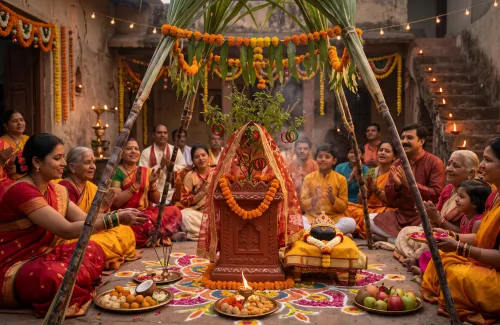
In the home, the ritual is joyful. The Tulsi pot is decorated as a bride with a red cloth, bangles and flowers, often with a small mandap of sugarcane stalks around it, and the Shaligram or an image of Vishnu stands as the groom. Many households treat it as a real wedding, complete with songs, sweets and neighbours as guests. Tradition permits Tulsi Vivah anywhere from Prabodhini Ekadashi through Kartik Purnima.
How the day is observed
- The fast. The vrata is traditionally begun on Dashami, the day before, with a light meal, and continues until parana. Grains and pulses are avoided. Devotees keep a fruit-based (phalahari) fast, and some observe a stricter waterless one. Anyone who is unwell, elderly, pregnant or on medication should choose a gentler form, and tradition itself values sincerity over severity.
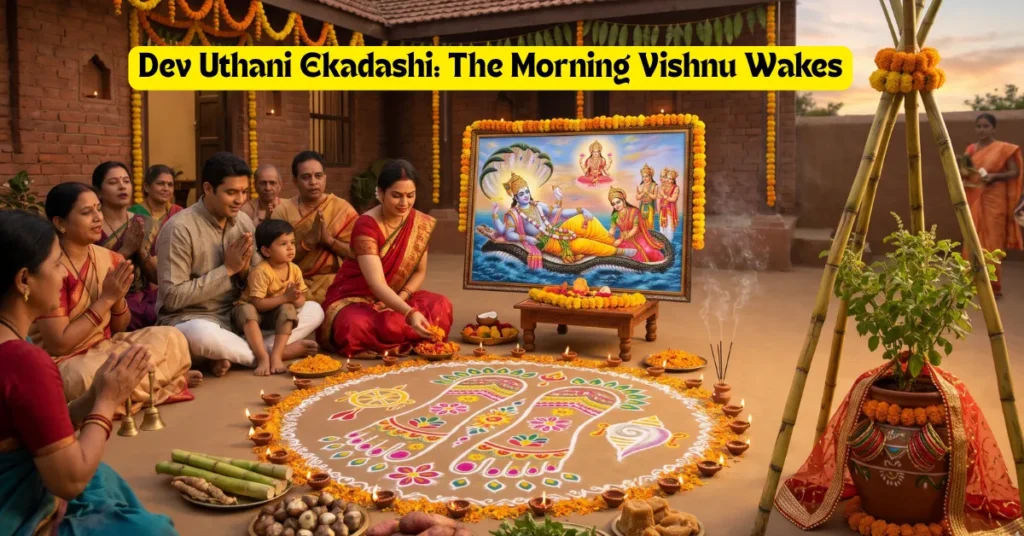
- Waking the Lord. At dawn or in the evening, families sing a wake-up verse beginning Uttishthottishtha Govinda (“Arise, arise, O Govinda”). In many homes, people draw a picture of Vishnu’s feet or form in rice flour on the floor, light lamps around it, and offer seasonal fruits and vegetables.
- Seasonal offerings. Sugarcane, water chestnut (singhara), sweet potato, jaggery, and Tulsi leaves feature widely, reflecting the harvest the season brings.
- Katha and mantra. The Ekadashi story is read or heard, and Om Namo Bhagavate Vasudevaya is chanted. Tradition holds that observing the Prabodhini vrata brings merit comparable to the Ashwamedha sacrifice.
- Charity. Giving food, clothes or money to the needy is considered especially meritorious on Ekadashi.
Why Kartik matters
The Puranas praise Kartik as one of the most sacred months. A line attributed to the Padma Purana’s Uttara Khanda says that, of all plants, Tulsi is dearest to the Lord; of all months, Kartik; and of all days, Ekadashi. The prescribed disciplines include rising before dawn, tending the Tulsi, lighting lamps in the evening, eating simply and giving in charity. Dev Uthani Ekadashi can be seen as the culmination of that month-long rhythm.
For those observing this year, the practical advice is simple: confirm the date with your own tradition or local panchang, keep the fast in a way that suits your health, and spend the evening by the Tulsi with a lamp and the people you love.
