

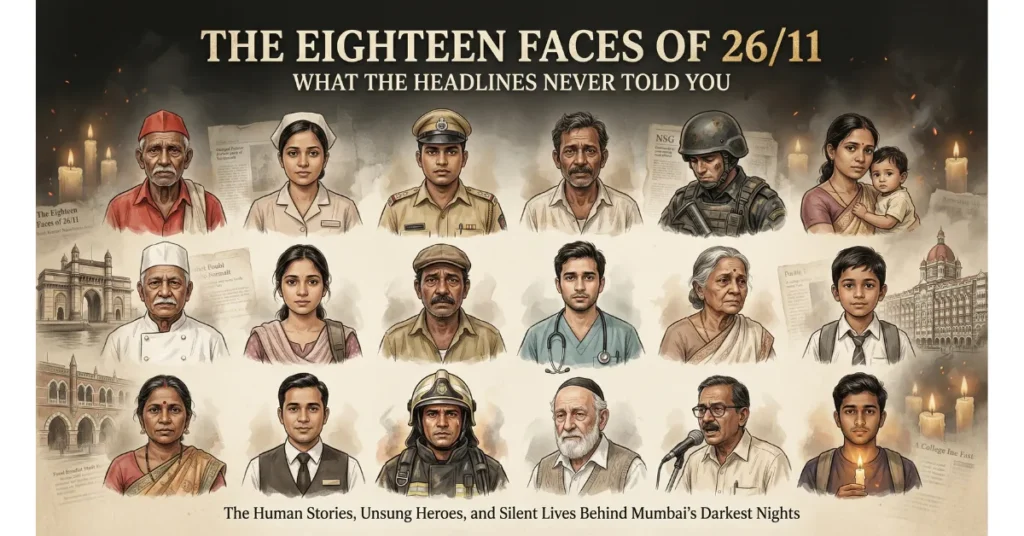
Eighteen years ago tonight, ten men came ashore in Mumbai. Most of us know the outline: the Taj, the Oberoi-Trident, Chhatrapati Shivaji Terminus, Nariman House. Beneath that outline sit smaller details that explain how the attack happened and who stopped it.
The attack had a Kolkata connection
The plot reached into the city where many of us live. Investigators said suspects arrested in Kolkata bought at least 22 phone cards under false names and sent them to Pakistan. Kolkata’s police commissioner at the time said at least five SIM cards used by the gunmen had been traced to the city. Part of the logistics of a terror strike on Mumbai was arranged through ordinary mobile shops in eastern India.
The boat that gave the game away
The attackers hijacked an Indian fishing trawler, the Kuber, to cross the final stretch of sea. They killed four crew members and forced the captain to steer toward Mumbai. Left behind on the abandoned vessel, ordinary items became evidence. Wheat flour, dental gel and shaving cream aboard all carried “Made in Pakistan” tags, and a satellite phone held records of the handlers’ conversations. Later, Kasab’s DNA matched samples recovered from the trawler. The attackers planned for months, yet their own supplies tied them to their origin.
They were taught Hindi, and given a disguise
The ten came from across the border, so their handlers prepared them for the city. The handler Zabiuddin Ansari, alias Abu Jundal, taught Hindi to all ten, and his trial is still underway. Kasab was also reportedly carrying a fake ID with a Hindu name and a sacred thread on his wrist. The plan was that if he died, the world would first read the dead attacker as a local, and the true origin would surface only later. He was captured alive, and that plan failed.
Pocket money for a massacre
The scale of the damage contrasts sharply with what the men carried. Their kit included AK-47s, pistols, hand grenades, about 8 kg of RDX, Rs 6,200 in cash, credit cards and multiple SIM cards. Rs 6,200 for a three-day siege that killed 166 people.
The nanny who ran
At Nariman House, the Chabad centre, Sandra Samuel was cleaning the kitchen after dinner, heard a commotion and assumed it was firecrackers. She worked for the Holtzbergs as nanny to their two-year-old son Moshe. Rabbi Gavriel and Rivka Holtzberg were killed. Sandra found the boy and carried him out to safety. Little Moshe grew up in Israel, and he has since returned to India to meet the woman who saved him. The story shows what an ordinary woman did when it counted.
A nine-year-old witness
Devika Rotawan was nine years old when she was shot in the leg at CSMT. She later stood in a Mumbai courtroom and identified Kasab as one of the gunmen. A child testified against a hardened terrorist, and her evidence helped the prosecution.
The constable’s bare hands
Assistant Sub-Inspector Tukaram Omble, a former soldier, was armed with only a lathi when Kasab’s car approached a checkpoint at Girgaum Chowpatty. He grabbed the barrel of Kasab’s rifle and held on as bullets tore into him, so that colleagues could overpower the attacker. A retired army man who joined the Mumbai police played a key role in arresting Kasab, the lone survivor. Without Omble, no one would have lived to witness the plot.
The host who stayed
Karambir Kang, the Taj’s general manager, lost his wife and two sons inside the burning hotel. He kept working through the siege, helping guests and staff while his own family was in danger. Many Taj employees stayed at their posts and helped guests escape through back corridors and kitchens. Several paid with their lives.
The warning that was heard, and the reforms that followed
It is uncomfortable to ask whether the tragedy could have been prevented. A book by a former Intelligence Bureau officer describes how, before the attacks, a senior J&K police official had identified a channel through which Lashkar-e-Taiba was procuring Indian SIM cards. Intelligence services watched that pipeline, and the author describes the dilemma of whether to arrest or to observe. The memoir does not claim to settle that question, and neither will I.
The aftermath changed India’s security map. Coastal surveillance was strengthened, and regional NSG hubs were set up in Mumbai, Chennai, Hyderabad and Kolkata. Kasab was sentenced to death in 2010 and executed two years later. The execution was carried out quietly in Pune’s Yerwada jail, and the news became public only after it was done.
Why it still matters
The headline numbers—ten gunmen and sixty hours—are only half of 26/11. The rest is made of people: a constable with a stick, a nanny with a toddler, a child in a witness box, a hotelier who kept working. The attackers reached the city by sea and bought their SIM cards in a shop. The people who stopped them were ordinary, and for many, the day began like any other.
Eighteen years on, Mumbai remembers, and so do we.
