


There is a particular kind of loneliness that lives inside a relationship — the kind that comes not from distance, but from silence. Many women know exactly what they want in bed but still there exists a lack of sexual communication. They can feel it, imagine it, crave it. And yet, when the moment comes to say it out loud, the words dissolve.
What remains is a quiet performance of satisfaction, a polite smile, and a private ache that never quite goes away.
Sexual communication between partners should feel natural. But for millions of women, it is one of the hardest conversations to start. So why is that? And what makes it so difficult for women to simply ask for what they want?
The answer lives at the intersection of culture, fear, and language — three forces that have, for generations, conspired to keep women’s desires unspoken.
The Weight of Judgment:
From a very young age, women are handed a script. Be desirable, but not too eager. Be open, but not too wild. Enjoy intimacy, but don’t want too much.
This script is written by society, reinforced by media, and whispered through the judgments of peers. It creates a deep and exhausting paradox: women are expected to be sexually appealing while simultaneously being expected to have few sexual needs of their own.
The fear of judgment is perhaps the heaviest wall standing between a woman and honest sexual communication. Voicing a desire feels like an exposure. It is not just saying I want this — it feels like saying this is who I am — and then waiting, heart in throat, to find out if that person will be accepted or rejected.
This fear is not irrational. It is a learned response to a world that has historically labeled sexually expressive women with unflattering words while celebrating the same behavior in men. Even in 2026, the double standard breathes.
Women internalize it so deeply that the judgment they fear is often no longer coming from outside — it is coming from within.
Sexual Shame: The Quietest Barrier to Bedroom Communication
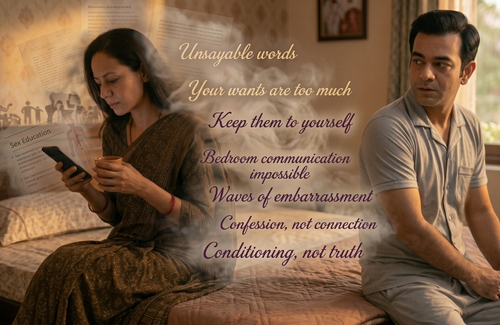
Closely related to the fear of judgment is shame — a quieter, more insidious force. Sexual shame does not announce itself. It simply sits in the body and makes certain words feel unsayable.
Many women grew up in households where sex was never discussed openly, where bodies were sources of embarrassment rather than belonging, and where desire was treated as something to be managed rather than celebrated. That silence teaches a lesson without ever speaking it:
Your wants are too much. Keep them to yourself.
Shame makes bedroom communication feel impossible. A woman may desperately want to ask for something but find that the moment she tries, a wave of embarrassment crashes over her — not because her desire is wrong, but because she has spent years being told, implicitly or explicitly, that it is.
Asking, then, feels not like sexual communication — it feels like confession.
Recognizing that shame is not truth, but conditioning, is the first step toward reclaiming your voice in the bedroom.
The Sexual Vocabulary Gap:
Even when a woman has worked through fear and shame, she often hits a third wall: she simply does not have the words.
Warm, honest, everyday language to say I like this or I’d love it if you tried that is rarely taught. Most women’s sexual vocabulary comes from two deeply imperfect sources — clinical textbooks and pornography. Neither offers the kind of grounded, real language needed for genuine sexual communication with a partner.
Clinical language feels cold and detached. The language of pornography is performative and often disconnected from real pleasure.
This matters more than most people realize. Language shapes thought. When we do not have words for something, it becomes harder to think about clearly — let alone express to another person. A woman who has never heard desire discussed in shame-free, accessible language may genuinely struggle to express her sexual desires, not because she doesn’t know what she wants, but because no one ever handed her the vocabulary.
Sex education could close this gap — but in most places, it covers biology and risk, and stops well short of teaching bedroom communication or the language of pleasure.
The Partner Problem:
It would be incomplete to talk about sexual communication without acknowledging what women are often responding to. Communication is a two-way street — and many women have learned through experience that expressing their desires does not always go well.
A partner who reacts with defensiveness (so I’ve been doing it wrong?), dismissiveness (you’re overthinking it), or visible discomfort can teach a woman very quickly that staying quiet is safer.
One bad reaction can undo years of building the courage to speak.
And so women learn to read the room, to measure their words, to decide whether the reward of being heard is worth the risk of that reaction. This does not mean partners are villains — often they are simply equally unprepared for these conversations.
But it does mean that sexual communication in relationships is not solely a woman’s work. It requires partners who are genuinely curious, patient, and interested in what a woman actually wants — not just what she performs.
How to Start the Conversation: Practical Bedroom Communication Tips?
The good news is that silence is a habit — and habits can change. Sexual communication is a skill, not a personality trait. It can be built, practiced, and deepened over time.

Here is where to start:
1. Talk Outside the Bedroom:
Bring the conversation to a calm, low-pressure moment — over coffee, on a walk, during a quiet evening. This removes much of the vulnerability. It makes desire a topic rather than a confession, and makes bedroom communication feel like a natural extension of the relationship.
2. Build Your Sexual Vocabulary:
Read, listen to podcasts, or follow voices that talk about women’s sexual wellness honestly and warmly. When women hear their own experiences reflected back in clear, shame-free language, the words become possible. A richer vocabulary makes sexual communication easier and more natural.
3. Get Clear on What You Want:
Before expressing your desires to your partner, spend time understanding what those desires actually are. Reflect on what has felt good. What you have imagined. What you have wanted but never said. You cannot ask for what you have not yet allowed yourself to want.
4. Use “I” Language:
Instead of you never do this, try I really love it when… or it feels amazing when…. This removes blame and turns the conversation into an invitation rather than a critique. It shifts sexual communication from correction to connection.
5. Let It Be Imperfect:
The conversation does not have to be perfectly worded or completely comfortable the first time. It just has to happen. Stumbling through it honestly is infinitely more powerful than staying silent to avoid awkwardness.
Women’s Sexual Wellness in 2026: Something Is Shifting
In 2026, the conversation around women’s sexual wellness has grown louder, braver, and more mainstream. More women are recognizing that pleasure is not something to earn after exhaustion — it is not selfish, and it is not too much to ask for.
The idea of purposeful pleasure — being intentional, present, and honest about intimacy — is increasingly seen not as a luxury but as a foundation of healthy relationships. Research consistently shows that women who feel emotionally safe and understood in their relationships report significantly higher sexual satisfaction.
Also Read: 5 Interesting Facts About Women Expressing Their Sexual Interest
When emotional intimacy and sexual communication are treated as connected rather than separate, the pressure drops, the performance fades, and real desire has room to emerge. The bedroom is not separate from the rest of the relationship. It is a reflection of it.
Your Desires Matter:
Women’s silence in the bedroom is not a personal failing. It is a cultural inheritance — shaped by generations of messaging that treated female desire as irrelevant, dangerous, or shameful. Unpacking it takes time, patience, and self-compassion.
But here is what is true: a desire spoken is a desire that stands a chance of being met. Honest sexual communication — however imperfect, however nervous, however small to begin with — is the bridge between what you have and what you actually want.
Every woman deserves to cross it. If you have been wondering why it feels so impossible to ask for what you want — know that you are not broken. You are navigating a system that was never designed to make this easy. The fact that you are asking the question means the silence is already beginning to crack. And that is where everything changes.