

The Quiet Theatre Behind Indian Elections
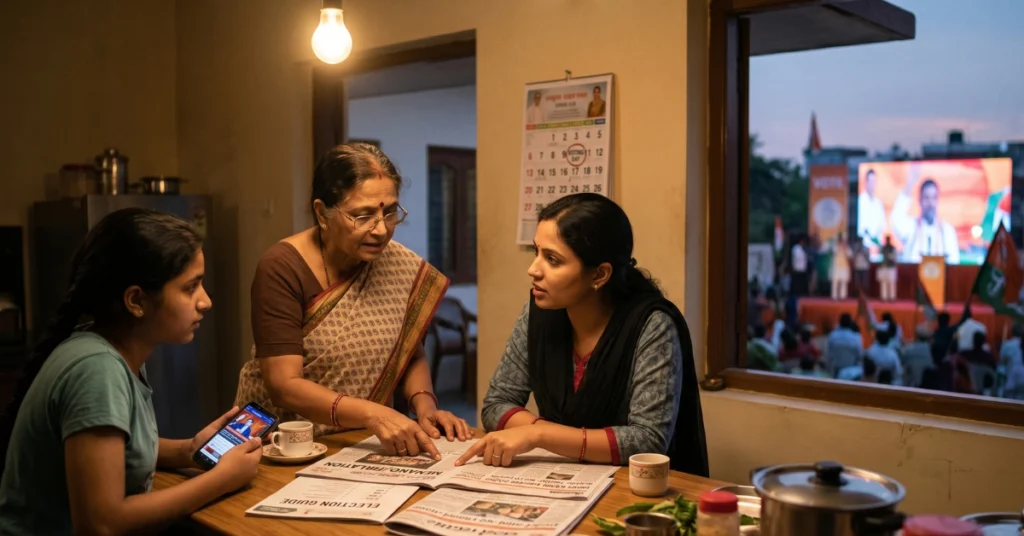
In countless homes across the country, political discussion does not begin with ideology; it begins with lived experience. A rise in the price of cooking oil, the reliability of electricity, and the accessibility of healthcare are not abstract concerns but daily realities, often first articulated by women.
The Kitchen as a Space of Political Thought
It is in kitchens, over the preparation of meals, that such matters are discussed with a candour rarely found in public discourse. Women, who manage the delicate balance of household needs, become interpreters of governance, translating policy into its practical consequences.
This translation is central to understanding how women influence voting decisions in India. Their authority does not arise from formal power but from proximity to everyday life. When a mother remarks that expenses have become harder to manage, or when a daughter questions whether a government scheme has truly delivered, these observations carry a weight that is difficult to dismiss.
The Household as a Collective Decision-Making Unit
Shared Choices, Subtle Influence
The Indian household often functions as a collective unit of decision-making. While the act of voting is individual, the process leading to it is frequently shared. Women play a role that is both subtle and decisive—they listen, weigh, and question, shaping the consensus that guides the final choice.
Their influence is rarely asserted openly; instead, it is woven into conversation and quiet persuasion. It is this understated presence that makes their role so enduring and effective.
Beyond the Home: Community Conversations
Grassroots Networks and Trust
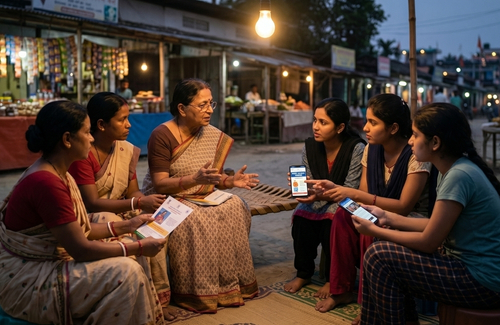
Beyond the household, women extend their influence into the wider community. In villages and small towns, informal gatherings—self-help groups, courtyards, and marketplaces—serve as spaces for exchanging ideas.
Here, discussions are driven not by political allegiance but by shared experience. A welfare scheme that benefits one woman becomes a subject of discussion for many. Trust, rather than authority, becomes the foundation of persuasion.
Urban Shifts and Digital Awareness
The Role of Technology in Political Dialogue
In urban India, the dynamics are more layered. The spread of information through platforms like WhatsApp and YouTube has introduced new dimensions to political awareness.
Younger women often act as interpreters of this information, bringing new perspectives into family discussions. Despite this digital shift, the ultimate influence still returns to the home, where ideas are tested against everyday realities.
Women as Evaluators of Governance
Increasingly, women are not just recipients of policy but evaluators of it. Government initiatives related to healthcare, financial inclusion, and welfare are judged by their actual impact.
Questions such as whether a benefit has reached the household or improved daily life are asked with quiet persistence. These evaluations shape not only individual opinions but also influence the thinking of families and communities.
Also Read: Woman Times 13th Issue
Political Recognition of Women’s Influence
Political parties have begun to recognise this subtle yet significant power. Campaigns now address issues that directly affect women, acknowledging their role not just as voters but as influencers.
However, the full extent of their impact remains difficult to measure because it does not conform to conventional ideas of visible political power.
The Silent Force of Democracy
To understand how women influence voting decisions in India is to recognise that democracy is not only expressed in polling booths but nurtured in everyday life. It is shaped by conversations that leave no record and by judgments formed in the rhythm of daily existence.
Indian women influence elections by shaping family opinions, guiding community conversations, and interpreting policies through real-life experiences. Their subtle yet steady voice plays a decisive role in how voters across India ultimately make their choices. From kitchen to constituency, this journey is quiet and almost imperceptible. Yet, it is precisely in this quietness that its strength lies—for the most enduring influences are often those that speak the least, but shape the most.


One Response