

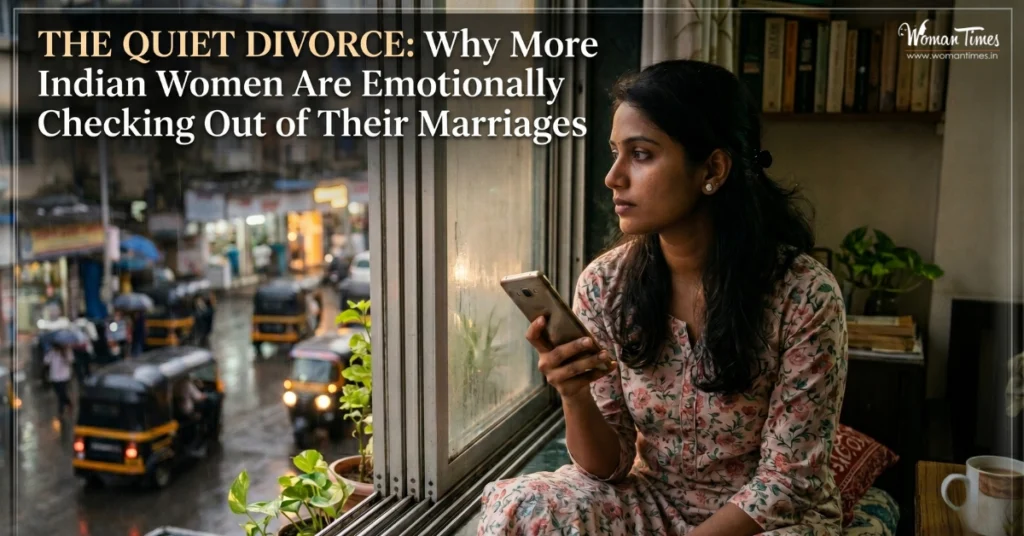
She Is Still There. But Not Really. Every evening, Meera sits at the dining table with her husband and two teenage children. The television hums in the background. Her son talks about college applications. Her daughter scrolls through Instagram between mouthfuls of dinner. Her husband discusses office politics without looking up from his phone. To an outsider, it is an ordinary Indian family sharing an ordinary meal. But inside, Meera feels absent.
She nods when spoken to. She serves the food. She remembers everyone’s schedules and doctor’s appointments. Yet somewhere along the way, she stopped sharing her thoughts. She stopped expecting to be heard. She stopped hoping for conversations that went beyond logistics. No dramatic fights took place. No betrayal shattered the marriage. No lawyer’s notice arrived at the door.
Instead, something quieter happened. The relationship slowly emptied itself of intimacy, companionship, and emotional connection. The marriage survived.
The love did not.
Across urban and semi-urban India, increasing numbers of women are finding themselves in a similar place—still married on paper, yet emotionally checked out. Relationship experts now have a name for this phenomenon: the quiet divorce.
What Is the Quiet Divorce?
Quiet Divorce Definition: A quiet divorce occurs when a couple remains legally married but has emotionally disengaged from the relationship. They continue to live together, share responsibilities, and maintain appearances, but the emotional bond, intimacy, and partnership have largely disappeared.
Unlike legal divorce, there is no court proceeding. Unlike separation, the couple still shares a home. Unlike the silent treatment, the disengagement is not temporary or strategic. A quiet divorce is often a long-term emotional withdrawal where two people stop investing in the marriage while continuing to perform its duties.
Why It’s Rising Among Indian Women Right Now
India’s cities are changing faster than its relationships. Family courts in metropolitan centres such as Delhi, Mumbai, Kolkata, and Bengaluru have reported steadily increasing divorce filings over the past decade. Yet legal divorce tells only part of the story. Behind those numbers lies another shift. More women today have financial independence than previous generations. They have careers, support networks, and access to conversations around mental health. Social media, therapy, podcasts, and online communities have introduced language for feelings that earlier generations often endured in silence.
Many women are no longer asking, “Can I survive outside this marriage?” They are asking, “Can I continue surviving inside it?”
The stigma around discussing marital dissatisfaction remains strong, particularly outside metropolitan circles. But emotional awareness has grown. Women increasingly recognise that loneliness can exist even while sharing a bed, a surname, and a home.
The result is not always divorce. Often, it is emotional withdrawal.
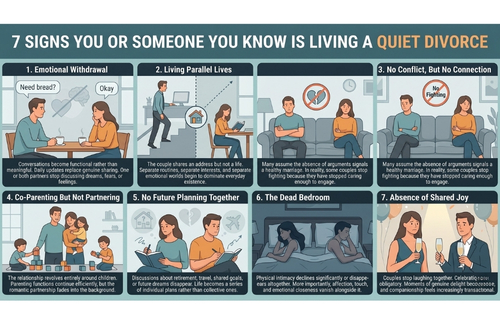
7 Signs You or Someone You Know Is Living a Quiet Divorce
1. Emotional Withdrawal
Conversations become functional rather than meaningful. Daily updates replace genuine sharing. One or both partners stop discussing dreams, fears, or feelings.
2. Living Parallel Lives
The couple shares an address but not a life. Separate routines, separate interests, and separate emotional worlds begin to dominate everyday existence.
3. No Conflict, But No Connection
Many assume the absence of arguments signals a healthy marriage. In reality, some couples stop fighting because they have stopped caring enough to engage.
4. Co-Parenting But Not Partnering
The relationship revolves entirely around children. Parenting functions continue efficiently, but the romantic partnership fades into the background.
5. No Future Planning Together
Discussions about retirement, travel, shared goals, or future dreams disappear. Life becomes a series of individual plans rather than collective ones.
6. The Dead Bedroom
Physical intimacy declines significantly or disappears altogether. More importantly, affection, touch, and emotional closeness vanish alongside it.
7. Absence of Shared Joy
Couples stop laughing together. Celebrations feel obligatory. Moments of genuine delight become rare, and companionship feels increasingly transactional.
The Difference Between a Rough Patch and a Quiet Divorce
Every marriage experiences periods of distance. A rough patch is marked by frustration, misunderstanding, or conflict—but both partners still want the relationship to improve. A quiet divorce is different. The defining feature is not anger but indifference.
In a rough patch, there is still emotional investment. In a quiet divorce, there is emotional resignation. One seeks solutions. The other has stopped searching for them. Recognising this distinction is important because temporary distance does not necessarily signal the end of a marriage.
What Keeps Indian Women in Quiet Divorces Longer Than They Should
The answer is rarely simple. For some women, it is the children. For others, it is financial dependence or fear of social judgment. Many remain because of elderly parents, family expectations, religious beliefs, or concern about public perception. And then there is hope. Hope can be both healing and imprisoning. The hope that things will improve. The hope that a difficult phase will pass. The hope that the person they once loved will return. These are not irrational reasons. They are deeply human ones. Which is why quiet divorces often continue for years before anyone acknowledges them.
Real Voices: What Women Are Saying?
“I realised we hadn’t had a meaningful conversation in almost three years. We discussed bills, school fees, and groceries. Nothing else.” — Priya, 42, Mumbai
“People say we’re the perfect couple. We never fight. That’s because neither of us cares enough anymore to argue.” — Anonymous, 38, Kolkata
“The hardest part isn’t loneliness. It’s pretending you’re not lonely while sitting beside someone every day.” — Ruhi Sinha, 47, Pune
These stories differ in detail but share a common theme: emotional absence hidden behind social normalcy.
Can a Quiet Divorce Be Reversed? What Experts Say
Relationship counsellors stress that emotional disconnection does not always have to become permanent. Many marriages recover when both partners acknowledge the problem and commit to rebuilding trust, communication, and intimacy. According to family therapists, the first step is often the hardest: naming what is happening. Couples therapy, structured communication exercises, and intentional time together can help restore connection when both individuals remain willing participants.
However, experts also caution that reconciliation requires effort from both sides. One person cannot revive a partnership alone. Hope is valuable. But hope without action rarely changes outcomes.
Also Read: Childfree by Choice at 30: Women on the Decision, the Judgment, and Zero Regrets
When Leaving Is the Right Answer and How to Begin?
Not every marriage can or should be saved. If emotional neglect is accompanied by abuse, manipulation, chronic disrespect, or severe psychological distress, seeking professional support becomes essential. Leaving does not always begin with packing a suitcase. Sometimes it begins with a conversation. Sometimes with therapy. Sometimes with financial planning. At some other times with admitting the truth to yourself.
For women considering their options, trusted friends, counsellors, support groups, and legal advisors can provide guidance without judgment. The quiet divorce is not merely a relationship trend. It is a reflection of a larger social shift. Indian women are increasingly recognising that a successful marriage is not defined by longevity alone, but by connection, respect, and emotional presence. And perhaps the most important question is not whether a marriage survives. It is whether the people within it feel alive.