

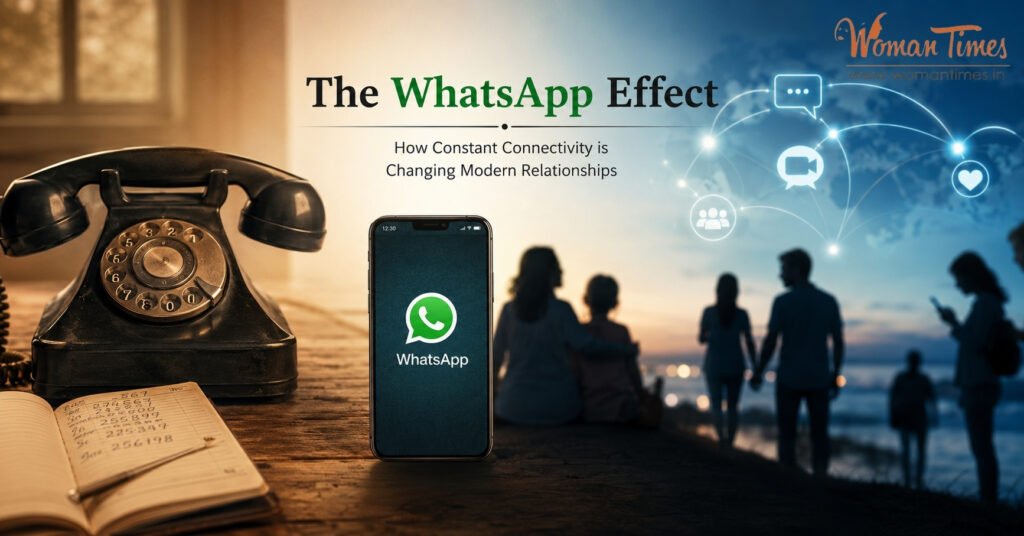
Maria Bhattacharya, former General Manager, West Bengal State Office, Indian Oil Corporation Limited (IOCL), reflects on how communication has changed dramatically over the past five decades. From rotary telephones and STD booths to smartphones and WhatsApp, technology has made communication faster and easier than ever. But has being constantly connected necessarily made our relationships deeper?
Travelling Through Time
When Maria thinks about communication during her school days in the 1970s, she remembers diaries filled with telephone numbers and fingers moving around the rotary dial of the black telephone. Having a telephone at home was a privilege. Others depended on public telephone booths or operator-assisted calls.
Long-distance communication was even more difficult. STD calls were expensive, and while speaking, people would keep an eye on the meter because every passing minute added to the cost.
When Maria and her husband were posted to Guwahati while their elder daughter stayed with her grandparents in Kolkata, they immediately went to an STD booth to call her. The receiver passed between the parents as their little daughter happily continued talking, while the meter kept running.
Phone conversations were therefore precious. Friends, students, couples and families spoke for long periods and often fixed a particular time for a call. Even simple signals, such as giving two rings and disconnecting, could reassure parents that their children were safe.
Technology gradually changed. Rotary phones became button phones, then cordless phones and eventually mobile phones. Early mobiles were expensive and bulky, but over time they became smaller, affordable and more useful. By 2008, when Maria’s daughter was studying medicine away from home, mobile phones made it possible for her to speak to her family without depending on a hostel or college landline.
Today, smartphones provide instant calls, video chats, messages, photographs, entertainment and countless other services. Sometimes, we do not even need to dial a number. A simple “Hey Siri, call Mom” is enough.
The Convenience of Constant Connectivity
WhatsApp has brought many positive changes. It has helped people reconnect with old friends, stay in touch with family and coordinate work quickly.
Maria’s school friends, whom she had almost lost touch with, came together through a WhatsApp group. They now share memories, photographs, food, health tips and everyday experiences. Their conversations motivate them to walk, practise yoga and take better care of themselves.
Families have also benefited. Grandparents can see photographs and videos of grandchildren or speak to them through video calls. Parents can quickly receive school updates, while colleagues and business teams can share information instantly.
WhatsApp has also proved useful during emergencies, helping people organise blood donations, locate missing persons and support those in need.
Clearly, technology has reduced distances and brought the world closer.
Also Read :From Design Dreams to Café Delights: Urvashi Basu Dual Journey
But Are We Really Connecting?
Despite these benefits, constant digital communication can sometimes reduce genuine personal interaction.
Earlier, a phone call with an old friend meant uninterrupted conversation, laughter and sharing experiences. Today, conversations are often broken into short messages, emojis, reactions and voice notes spread throughout the day. We communicate more, but sometimes connect less deeply.
A message or photograph can keep us informed about distant relatives, but it cannot completely replace visiting them and spending time together. Similarly, WhatsApp groups at workplaces may make communication faster, but they cannot always replace face-to-face meetings where people understand each other’s concerns and ground realities.
Constant connectivity has also blurred the boundary between work and personal life. Messages received late at night or during holidays can create pressure to respond immediately, leaving little opportunity to truly switch off.
The younger generation faces another challenge: the expectation of instant replies. Blue ticks, likes and delayed responses can create unnecessary anxiety and misunderstandings. Social media can also make people compare their lives with the carefully selected happy moments posted by others.
Disconnect to Reconnect
Technology itself is neither good nor bad. Its impact depends on how we use it.
WhatsApp can strengthen relationships when it helps us stay connected, share happiness, support one another and remain close despite physical distance. But it should not become a replacement for personal meetings, meaningful conversations and shared experiences.
Over five decades, communication has expanded enormously. Earlier, our circle of contact was smaller, allowing us to invest more time and attention in each relationship. Today, that circle has grown across cities, countries and continents. Naturally, spreading our time across more people can sometimes reduce the depth of individual relationships.
Perhaps this is the real WhatsApp effect: we have more ways to communicate, but we must consciously make time to connect.
WhatsApp is only a tool. The responsibility for keeping relationships alive remains with us. We need to respect our own space and the space of others, rather than expecting everyone to be constantly available.
Sometimes, therefore, we need to disconnect—even briefly. Put the phone aside. Enjoy the laughter of a child, feel the breeze, smell the flowers, talk to someone face-to-face and simply be present.
Technology can keep us connected, but only people can create real connection.