

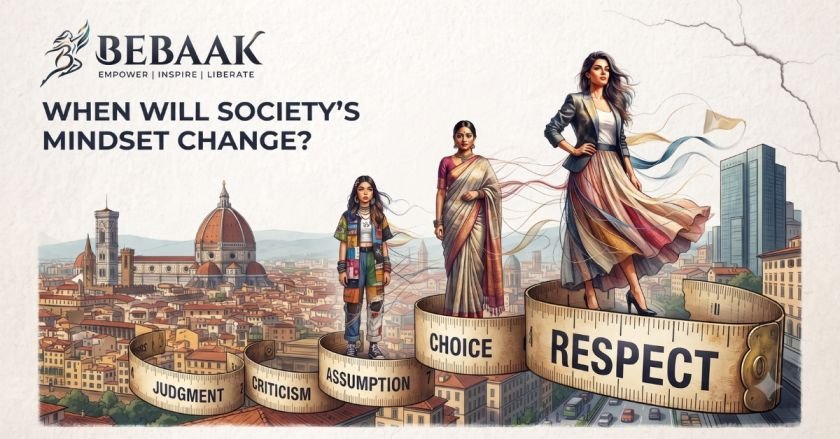
When will society’s mindset change?
Recent reports from Italy, a country the world associates with fashion, luxury and style, describe women being judged and criticised for what they choose to wear. What strikes me most is that this is not an Indian problem, or a problem of any one culture. It surfaces wherever women are watched more closely than they are heard.
In my view, the trouble was never the skirt, the burqa, the sari or the jeans. The trouble is a mindset that presumes to read a woman’s character, morality, reliability, even her fitness as a mother, from the fabric she wears. A woman’s dignity does not shrink with her hemline, and her values cannot be measured in meters of cloth.
I write this as a woman and as a police officer. I believe in discipline, dignity and responsibility in every sphere of life. But upholding professional decorum is one thing, and passing personal verdicts on a woman’s character is quite another. Respect cannot be ordered into existence through a dress code. It grows only when attitudes change.
The Italian episode also exposes an uncomfortable contradiction. Women are told what to uncover in the name of freedom and what to cover in the name of morality. When both instructions come from someone else, whose freedom is actually being protected? Real empowerment means a woman can choose for herself, free from coercion, humiliation, or discrimination.
What Gen Z might say?
For Gen Z, clothing is more than fashion. It is a way to express identity, show confidence, and claim personal freedom. Their outlook, as I understand it, can be put simply: my body, my choice, my identity.
To them, an outfit is not a character reference. A short skirt does not make a woman any less responsible, just as traditional dress does not make her automatically virtuous. Consent matters more than clothing, and what a woman wears is never an invitation to harassment, unwanted attention, or disrespect.
They would also argue that freedom must run in both directions. A woman who chooses a mini skirt and a woman who chooses a burqa each deserve to make that choice without being shamed or pressured. And respect, for them, is never conditional: a woman’s competence, intelligence and integrity should be judged by her work and conduct, not her appearance.
If asked to name the contradiction in today’s society, they would probably say: “You cannot preach women’s empowerment and practice body-shaming at the same time.”
It is a line worth pausing over. Yet freedom of expression does not require every generation to agree on fashion or lifestyle. It asks only that disagreement never become a license to humiliate, discriminate against or diminish another person.
Are we really changing?
We speak often of empowerment, equality and modernization. Women lead organizations, serve in uniform, run institutions, conduct scientific research and make decisions that shape society. And still, in many places, the same woman is expected to earn her respectability through the way she looks.
We say we want women to be independent, but often only within limits set by others. We applaud their achievements while still scrutinising their personal choices.
Progress will be real when a woman no longer has to defend what she wears before she is allowed to show what she can do. Freedom does not mean that every woman must dress in a particular way. It means that no woman is made to fit someone else’s picture of what a respectable woman should be.
The Italian incident reminds us that economic growth, global recognition and glamorous cities do not guarantee enlightened attitudes. A society can be technologically advanced, economically strong, and influential in fashion, yet still cling to deep-seated notions about how women should behave and present themselves.
A thought to end on:
I often wonder whether the next generation will finally break this cycle of judgment. Gen Z is questioning conventions that earlier generations accepted without a second thought, and that questioning is itself part of social change. But lasting change also needs empathy, responsibility, and mutual respect across generations.
The true test of a progressive society is not how fashionably its women dress, but how freely they can choose, without fear of ridicule or reprisal. Dignity, safety and equality are not matters of fashion. They are matters of human rights and basic respect.
A woman’s clothes cover her body, not her character. Her character lives in her actions, her values and the way she treats others. Until society grasps that simple truth, we may keep changing our fashions, our laws and even our governments, while remaining bound to the same old mindset.
So here is my question to society: when will we stop measuring women by their hemlines, and start measuring ourselves by the respect we give them?