

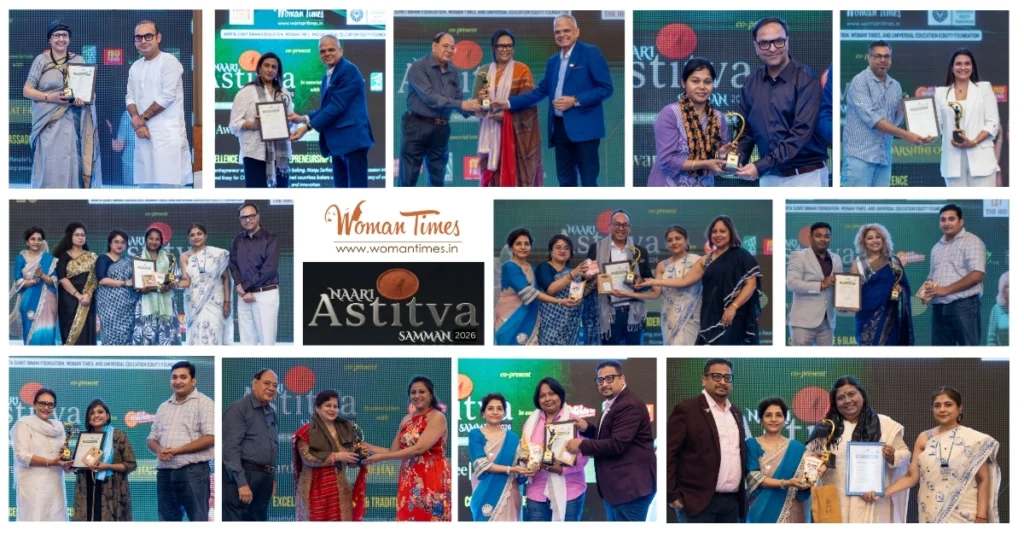
There are evenings in Kolkata when the air itself seems to carry memory—of conversations, of quiet revolutions, of voices that refuse to fade. The Naari Astitva Samman 2026, organised by Woman Times, was one such evening. It did not merely celebrate women; it paused, listened, and then gently placed their stories into the city’s living archive.
Co-hosted by the Mamta Sumit Binani Foundation under the stewardship of Dr CS Adv Mamta Binani, and the Universal Education Equity Foundation led by Dr Bratati Bhattacharyya, the event reflected a careful coming together of intent and institution. Supported by partners like Friends 91.1 FM, Adarsh Telemedia, Minu Fashions, Asparagus Events and Catering, and Jayanta Finance Corner, the evening carried both elegance and purpose.
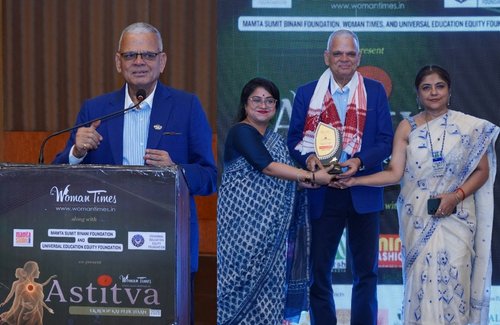
Gracing the occasion as Chief Guest was Rajendra Khandelwal, whose presence lent a certain gravitas to the proceedings. The gathering was further enriched by distinguished Special Guests—Prasenjit Ray (GM, ABP group), Amit Agarwal (Film Producer & Director of Adarsh Telemedia), Sayan Ganguly (Music Producer, Director & Pianist), Surajit Banerjee (MD, Fintech), Manab Paul (Founder of Sree Balaji Real estate), Indira Dhar (Film Director), and Ratan Jhawar (Owner, Sports n Screen) —each representing a facet of contemporary cultural and professional life.
At the heart of the ceremony stood Sohag Sen, honoured with the Lifetime Achievement Award. Though she could not attend the evening due to health concerns, her absence was felt with a quiet poignancy—reminding everyone that a lifetime of dedication does not require physical presence to be deeply acknowledged.
Food, often dismissed as domestic routine, found its rightful stature through Manju Sethia and Manzilat Fatima—one representing innovation in culinary entrepreneurship, the other preserving the fragile inheritance of taste and tradition. Their journeys reminded the audience that kitchens, too, can be sites of leadership and legacy.
Sport and melody arrived like twin notes of aspiration. Mouma Das, honoured for excellence in sports, carried the quiet discipline of years spent at the table, where reflex meets resolve. Meanwhile, Lopamudra Mitra, the voice of timeless melody, brought with her the intangible—songs that seem to belong to both yesterday and tomorrow.
In a world increasingly shaped by image, Jolly Chanda redefined glamour as confidence rather than ornament. Leadership found its voice in Priyadarshini Ojha, while Arpita Bhattacharjee and Nehal Maloo reminded us that art—whether cultural or spiritual—remains one of the most enduring forms of expression.
The evening did not overlook science and service. Dr Indrani Lodh stood for the deeply personal and often unspoken journeys of women’s healthcare, while Sampa Guha, honoured as Commander of Change, and Tampa Das, recognised for Dignity in Duty, reflected the quiet courage that rarely seeks recognition.
And then there was Kounteya Sinha.
Described as a “masculine female,” his recognition for Visual Storytelling & Gender Impact did not arrive with spectacle, but with a certain stillness. In that moment, the room seemed to understand that identity is not a fixed script but a lived experience—sometimes defiant, sometimes misunderstood, but always real. Her award, Blurring the Lines, was perhaps the most contemporary note in an otherwise classical composition—an acknowledgment that the idea of womanhood itself is evolving, stretching beyond inherited definitions.
The Naari Astitva Samman 2026 did not attempt to resolve these complexities. Instead, it did something far more important—it gave them space.
And in a city like Kolkata, where history is never too far from the present, that space becomes a quiet promise: that every story, no matter how conventional or unconventional, has its place in the larger narrative of who we are becoming.