

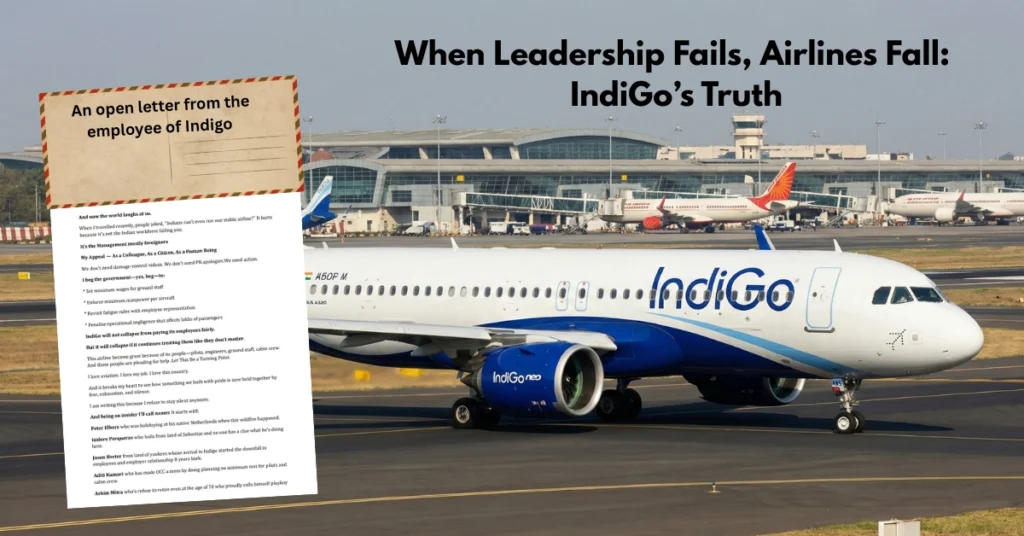
For years, IndiGo has been celebrated as India’s aviation success story — a symbol of efficiency, punctuality, and scale. But behind the glossy advertisements and the blue-and-white cabins lay a truth that has now exploded into public view: IndiGo did not collapse overnight. It has been unraveling quietly, painfully, and systematically, while the world looked away.
A recent open letter from an IndiGo employee has ripped the silence apart. It is not a corporate statement. It is not polished PR. It is the voice of someone who has lived the crisis from the inside — witnessing the exhaustion, the humiliation, and the slow erosion of an airline built with pride. This letter forces us to confront what India’s largest airline truly became: a company held together not by systems or leadership, but by overworked humans stretching themselves to the breaking point.
The Downfall Was Years in the Making:
IndiGo began its journey in 2006 with passion and professionalism. Employees believed in the airline, believed in the mission, and worked with their hearts.
But somewhere along the way, growth turned into greed, and pride turned into arrogance.
A culture developed where warning signs were ignored, fatigue concerns were dismissed, and employees were treated as expendable resources. Pilots who raised safety issues were intimidated. Ground staff earning as little as ₹16,000 ran from aircraft to aircraft doing the work of three people. Cabin crew cried in the galley and smiled at the aisle. Engineers juggled multiple aircraft because there simply weren’t enough hands to do the job safely.
And yet, the leadership message was brutally simple:
“You’re lucky to have a job.”
Or even worse:
“Beggars can’t be choosers.”
This is not how aviation is run. This is how aviation is ruined.
Titles Became More Important Than Talent
The employee’s letter reveals an internal ecosystem where promotions were driven not by capability, but by proximity to power. People who could barely draft an email were made Vice Presidents. Why? Because titles meant access to ESOPs, status, and unchecked authority.
And authority required justification. So the pressure on employees increased. Schedules became harsher. Rest periods were slashed.
Leaves were denied. Compensation never improved.
In short: the airline grew, but its people shrank.
The Human Cost: A Workforce Running on Empty
The shift from calling people “passengers” to “customers” was symbolic — a corporate instruction to strip away emotional connection. It signaled a mindset where numbers mattered more than lives.
But aviation is not a business of just numbers. It is a business of human responsibility.
How do employees serve with dignity when they themselves are exhausted, unheard, and broken?
The letter is clear:
They are not failing the passengers.
They have been failed by the management.

Where Was the Regulator?
The crisis is not a story of one airline alone. It is also a story of regulatory silence.
When pilots applied for licence validation to move abroad, the process was delayed — sometimes suspiciously. When fatigue rules were revised in ways that made schedules more punishing, no one stood up for the employees. When safety concerns were voiced repeatedly, they disappeared into bureaucratic darkness. India watched the airline grow. But the people who kept those planes in the sky were left behind.
The Crisis We Pretend to Be Shocked By:
The chaos we see today — delays, cancellations, angry passengers, stranded crew — is not unexpected. It is the inevitable explosion of a pressure cooker that has been whistling for years.
The world now mocks India’s aviation sector with comments like:
“Indians can’t even run one stable airline?”
And it hurts, because the Indian workforce has never failed.
They were simply overworked into collapse.
The letter names the leadership figures believed to have contributed to this downfall — from foreign executives disconnected from Indian realities to internal decision-makers who prioritised control over compassion.
It confirms what insiders whispered for years:
This crisis was preventable. But no one at the top listened.
Also Read: Street Dogs vs. Supreme Court: India’s Stray Animal Debate Heats Up
A Plea for Reform, Not PR
The employee does not ask for apologies or damage-control videos. They ask for action — real, urgent, systemic action:
-
Set minimum wages for ground staff.
-
Ensure minimum manpower per aircraft so people aren’t running themselves sick.
-
Revise fatigue rules with actual employee representation.
-
Penalise operational negligence that affects millions of passengers.
IndiGo will not collapse because it starts paying people fairly. It will collapse if it continues treating them as if they don’t matter.
The Truth We Must Not Ignore:
This letter is more than a complaint. It is a mirror. It reflects a workforce that once built India’s favourite airline with sincerity and pride.
It reflects an industry where silence was enforced, fatigue was normalised, and dignity was optional.
It reflects an aviation ecosystem that must now choose:
Will it protect its people, or will it repeat its mistakes?
The employee ends the letter with love — love for aviation, for their job, and for this country.
And heartbreak — heartbreak that something so beautiful has been reduced to chaos by poor leadership and systemic neglect.
If IndiGo wants to rise again, it must begin not with PR campaigns, not with press releases, but with an honest acceptance of one truth:
Airlines are not built on aircrafts. They are built on humans. And those humans are asking to be heard.