

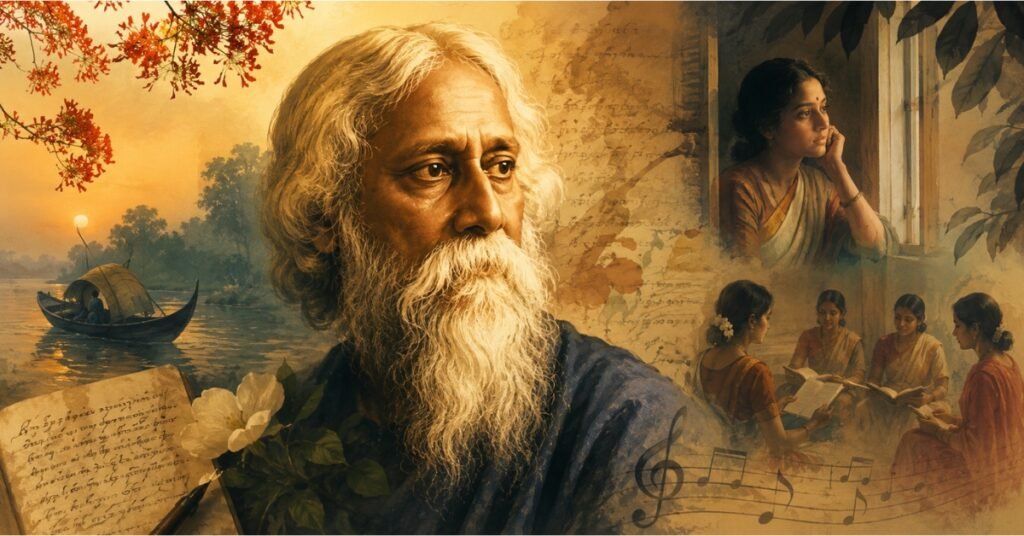
Bengal right now stands at the crossroads of religion-based political polarisation – something that is vehemently against Tagore’s own philosophy. Tagore is relevant across time and space because he wrote and sang for the mere human spirit. 85 years after his death, Bengali people all around the world still cling to his poems and have his songs run in their veins, like something essentially vital to our lives.
A polymath who rose above the barriers of language, culture and gender and helped unionise all and sundry under the spirit of shared struggles and how patriarchy and political turmoil don’t just affect men, but women too. What stands out in Tagore’s writing is how innately intricate his female characters are, not goddesses or flagbearers of chastity and sacrifice, but how utterly human they are, with their hearts filled to the brim with feelings that were deemed unnecessary and atrocious.
His songs and poems explore female autonomy like no other. He defied rigid social norms and sought educational rights and personal liberty for women via his characters. Binodini’s quiet rebellion against the patriarchal standards of widowhood and how she seeks to honour her heart’s desire, despite being aware of the repercussions of doing so. She is morally grey, not someone that you are supposed to look up to, but rather be comforted in knowing that the very human urges that you sustain have plagued women for a long time.
Charulata’s lonely heart wandered outside her marriage, longing for companionship and a friend. Loneliness was dethroned as something exclusive to the man who fights and earns and presented as something abysmally basal.
Also Read: From Temple to Stage: The Evolution of Sacred Dance to Modern Feminism
Tagore spruced his literary career with such endowments of the female perspective that at any point it becomes almost impossible to deny that he was a feminist in his own right, a wingman who tried to elevate women even before feminism was a thing. What he championed was to recognise that women have just as much dignity beyond their domestic participation.
Rabindra Sangeets have been a staple in any Bengali household. Almost any Bangali could sing a line or two. In countless Bengali households, his songs are instinctually present: sung during various festivals, rehearsed on rainy afternoons, played softly during moments of grief, celebration, longing, or solitude. Colored with emotions expressed by Murki and Meend, his songs also derive inspiration from Scottish and Irish folklores and tunes. What keeps these songs alive and relevant is the spirituality embedded in them. They navigate selfhood and personal liberty against the crushing material demands of life itself- transcending routine and conformity. His songs resonate with emotions and fragments of ourselves when time breaks us beyond repair and we fail to find words that define us.
Perhaps that is why Rabindranath Tagore continues to remain so deeply woven into the emotional fabric of Bengal, his works guiding us like a compass, not simply as a poet, songwriter, or novelist, but almost as a quiet guide people return to in moments of confusion, loneliness, and change. In a time marked by political division, emotional exhaustion, and an endless race for success, Tagore’s writings still feel startlingly intimate.
He believed freedom was never just about politics; it was also about the freedom to think, to feel, to question, and to exist with dignity. His female characters were not flat ideals or silent sufferers, they were conflicted, intelligent, angry, loving, flawed, and profoundly human. Through his songs, people found permission to grieve openly, to love deeply, and to sit with vulnerability without shame. Through his stories and poems, he gave language to emotions that many struggle to articulate even today: longing, alienation, resistance, heartbreak, and hope.
More than eighty years after his death, his presence still lingers everywhere in Bengali homes humming with Rabindra Sangeet, in classrooms, in theatre performances, in old letters, and in the emotional worlds people carry within themselves. His legacy endures because he understood something essential about human nature: people cannot live on ambition, routine, or survival alone. We survive through connection. Through art. Through being understood. And through the courage to remain fully, imperfectly, unapologetically human.