

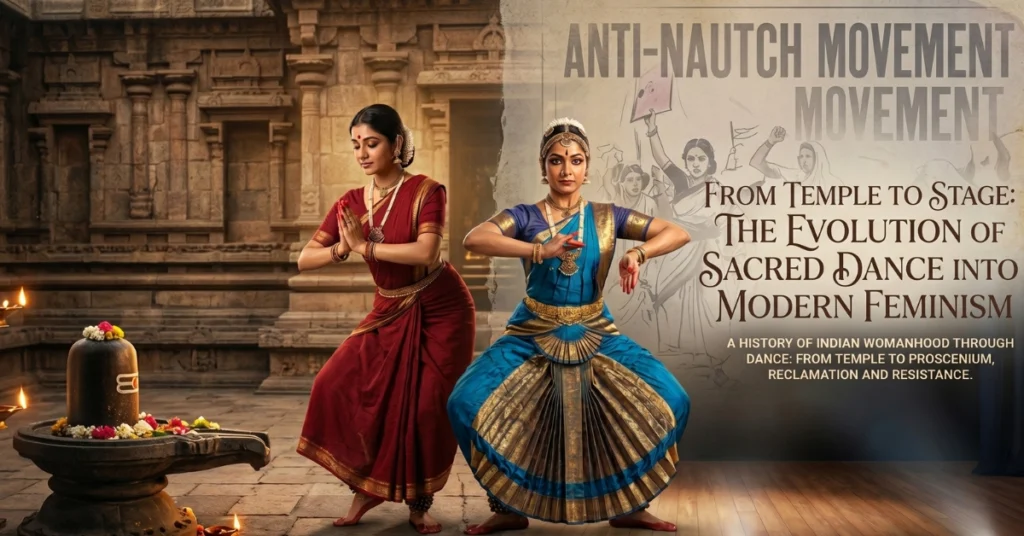
The journey of sacred dance to modern feminism in India is not merely a cultural shift—it is a story of devotion transforming into defiance.
There was a time in the Indian subcontinent when dance was not performance—it was prayer. The body was not an object to be watched but a vessel through which the divine spoke. In the dimly lit courtyards of temples, where oil lamps flickered against ancient stone, women moved not for applause but for transcendence. Their art was devotion, their audience the gods.
The Sacred Origins
In traditions such as Bharatanatyam and Odissi, dance emerged as an offering—a seva. The devadasis, often misunderstood through the lens of later moralities, were once custodians of sacred knowledge. Their movements were encoded with stories from the Natya Shastra, a text that did not merely describe performance but prescribed a philosophy: that art is a bridge between the human and the divine.
In these early centuries, the feminine was not marginal—it was central. The dancing body symbolised Shakti, the cosmic feminine energy. It was powerful, revered, and indispensable.
The Colonial Disruption: Sacred dance to modern feminism
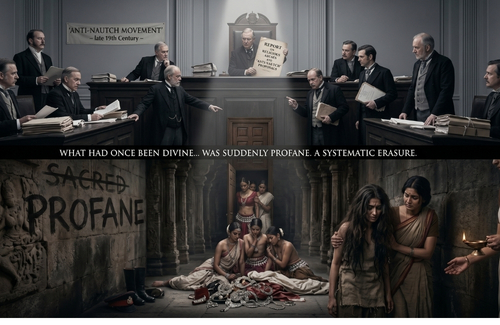
Then came the British, and with them, a moral gaze that neither understood nor cared to understand. The Anti-Nautch Movement of the late 19th century, driven by Victorian sensibilities, recast sacred dance as something indecent. What had once been divine was suddenly profane.
This was not merely a cultural misunderstanding; it was a systematic erasure. Temple dancers were stripped of their dignity, their roles dismantled, their art driven out of sacred spaces. The irony, as any historian would note, lies in the fact that a civilisation which had celebrated the sensual as sacred was now being taught to be ashamed of its own aesthetics.
Reinvention and Reclamation
The 20th century brought with it a quiet but determined resistance. Figures like Rukmini Devi Arundale and Balasaraswati reclaimed what had been lost. Yet, this reclamation was not without its complexities.
Dance moved from the temple to the proscenium stage. It was sanitised, restructured, and in many ways, rebranded to suit a newly emerging Indian middle class eager to rediscover its heritage—albeit in a more “respectable” form. The devadasi was replaced by the “classical dancer,” often upper-caste and socially acceptable.
It was a resurrection, yes—but one that came with selective memory.
The Feminist Turn: sacred dance to modern feminism
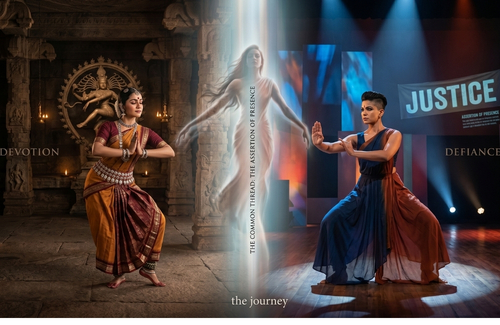
In contemporary India, dance has once again shifted its axis. Today’s dancers are not merely inheritors of tradition; they are interrogators of it. Through Bharatanatyam, Odissi, and contemporary forms, women are reclaiming narratives that were long denied to them. They speak of desire without apology, of autonomy without fear, and of identity beyond prescribed roles. The stage has become a site of resistance.
Themes once unthinkable—sexuality, patriarchy, violence, and freedom—now find expression in choreographies that challenge both audience and tradition. In doing so, dance returns, in a curious way, to its original purpose: truth-telling. This phase marks the true culmination of the journey of sacred dance to modern feminism, where movement becomes not just expression, but assertion.
Also Read: Indian Women Influence Elections: From Kitchen to Constituency
Between Devotion and Defiance
What is most striking, perhaps, is not the transformation itself but its continuity. The devadasi danced for the divine; the modern dancer often dances for justice. Yet both are bound by a common thread—the assertion of presence.
The journey from temple to stage is not simply a spatial shift. It is a narrative of loss and recovery, of silencing and voice. It reflects the broader story of Indian womanhood—revered, controlled, erased, and now, increasingly, self-defined.
In the measured cadence of a mudra or the defiant stillness of a contemporary pose, one can still glimpse the past. Not as a relic, but as a living, breathing force.
And perhaps that is the final truth: dance, like history, never truly disappears. It only changes its stage.