

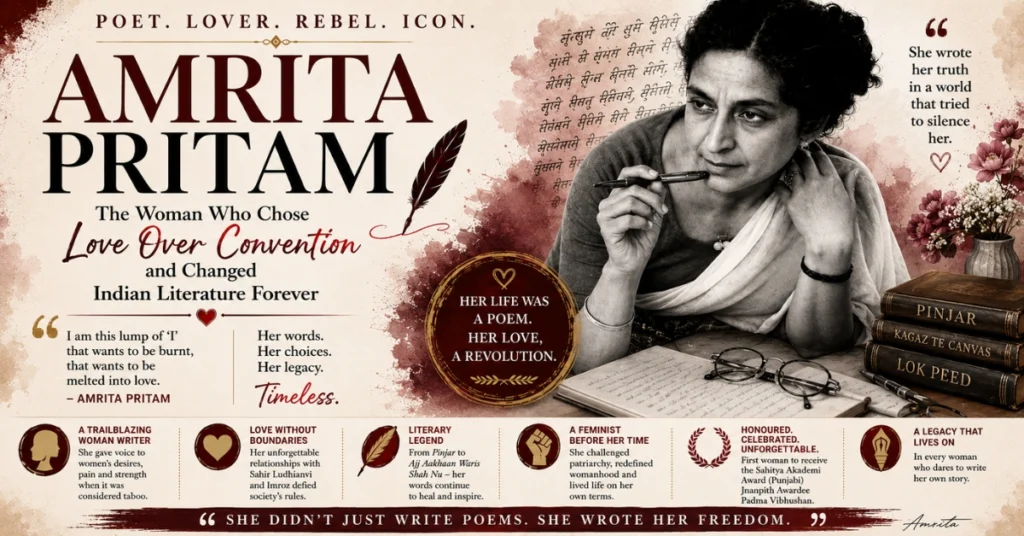
There are women who write about freedom, and then there are women who become freedom itself.
My first encounter with Amrita Pritam wasn’t in a bookshop or at a literary festival. It happened inside an English Literature classroom, where Pinjar was prescribed as part of our Gender Studies curriculum. Like most students, I initially approached it as another text to analyse for examinations. But somewhere between its pages, the boundaries between literature and life dissolved. Pinjar wasn’t merely a novel; it was an unsettling mirror reflecting the brutal realities of Partition, patriarchy and the female body as a contested territory. Long after I had forgotten the theories discussed in class, I remembered Puro—the woman at the heart of Pinjar—and, more importantly, I remembered the woman who had dared to create her.
That woman was Amrita Pritam.
There are women who write about freedom, and then there are women who become freedom itself. Amrita Pritam belonged to the latter. There are women who write about freedom, and then there are women who become freedom itself.
Amrita Pritam belonged to the latter.
Long before feminism became fashionable and women’s voices found space in panel discussions and social media campaigns, Amrita lived a life that quietly defied every rule society had written for women. She wasn’t loud for the sake of rebellion. She was fearless because silence was never an option.
Born in 1919 in Gujranwala, now in Pakistan, Amrita entered a world where daughters were expected to obey, wives were expected to endure, and women were expected to disappear behind the men they loved. Instead, she chose to write. And with every poem, she reclaimed a little more space—not only for herself, but for generations of women who would follow.
Her life, however, was never a fairy tale. It was a beautiful contradiction.
Married at the age of sixteen in an arranged marriage, Amrita soon realised that companionship cannot be manufactured through rituals. The marriage survived on paper but not in spirit. At a time when divorce was almost a social crime, she chose separation. Imagine the courage that demanded in the 1950s. A woman walking away from an unhappy marriage was judged more harshly than a man abandoning his responsibilities. Yet Amrita walked away with her dignity intact and her pen sharper than ever.
If her writing challenged society, her heart challenged convention even more.
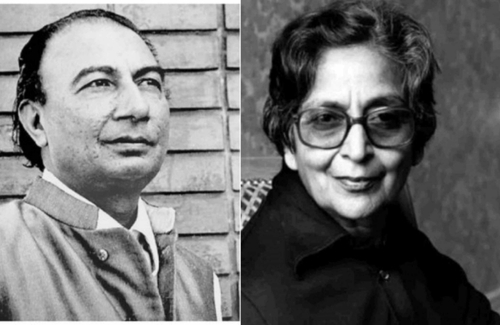
The most discussed chapter of her life remains her profound, almost mythical love for Urdu poet Sahir Ludhianvi. Their relationship was never fully lived in the conventional sense. It existed somewhere between poetry and longing, between presence and absence.
Stories from literary circles reveal that when Sahir visited her home, he would smoke endlessly, leaving behind half-finished cigarettes. After he left, Amrita would light those very cigarette butts, one after another, simply to feel closer to him. It sounds almost cinematic today, but for Amrita, love was never measured in possession. It was measured in remembrance.
Whether the stories have acquired the polish of legend hardly matters. They reveal something essential about her emotional landscape—she loved without apology.
Yet life had another surprise waiting.
Artist Imroz entered her world not as a replacement for Sahir but as a companion who understood that love does not demand ownership. Their relationship lasted more than four decades without the formal seal of marriage. They lived together in quiet companionship, creating one of India’s most enduring love stories.
Every morning, Imroz would drive her to work. It is said that while she sat beside him, he would trace the word “Sahir” with his finger on her back. He knew her past. He honoured it. Perhaps that was his greatest expression of love—not asking her to erase yesterday in order to belong to today.
Their relationship challenged another deeply rooted belief—that a woman could only define herself through marriage. They proved that commitment can exist without societal approval and that respect often outlives romance.
But reducing Amrita Pritam to her love life would be doing an injustice to a woman whose greatest romance was with truth.
The Partition of India scarred her soul forever. Having witnessed unimaginable violence, displacement and brutality against women, she wrote the haunting poem Ajj Aakhaan Waris Shah Nu, calling upon the legendary Punjabi poet Waris Shah to awaken and witness Punjab’s suffering once again. The poem remains one of the most powerful literary responses to Partition ever written.
Her novel Pinjar explored the trauma of women caught in communal violence with astonishing honesty. Long before conversations around gender violence entered mainstream discourse, Amrita was asking uncomfortable questions. Who owns a woman’s body? Can honour survive when humanity fails? Why are women always expected to carry the burden of men’s wars?
These questions remain painfully relevant even today.
Amrita was also among the first Indian women writers to speak openly about female desire. She refused to portray women merely as mothers, wives or daughters. Her women desired, questioned, rebelled, forgave and chose. They possessed agency at a time when literature often denied them one.
Naturally, critics were scandalised.
She was labelled controversial, immoral and rebellious. But history has an interesting way of correcting society’s judgments. The very woman once criticised for her boldness is now celebrated as one of India’s greatest literary voices. Recognition eventually followed. She became the first woman to receive the Sahitya Akademi Award for Punjabi literature and later received the Jnanpith Award and the Padma Vibhushan. Yet awards merely decorated what courage had already accomplished.
Also Read: ICC Women’s T20 World Cup Begins: The Complete Guide for Indian Fans
Perhaps the most fascinating fact about Amrita Pritam is this: she never asked permission to become herself.
She loved whom she wished to love. She left what no longer nourished her soul. She wrote what society preferred to hide. She embraced vulnerability without surrendering strength.
In today’s world of carefully curated identities and filtered authenticity, Amrita feels refreshingly real. She reminds us that empowerment is not always loud. Sometimes it is simply the quiet determination to live honestly, even when honesty comes at a price.
Her legacy is not confined to libraries or literature festivals. It lives wherever a woman chooses dignity over compromise, expression over silence and love over fear.
Nearly two decades after her passing, Amrita Pritam continues to whisper a timeless truth into the ears of every woman brave enough to listen: your story belongs to you. Write it before someone else does.