

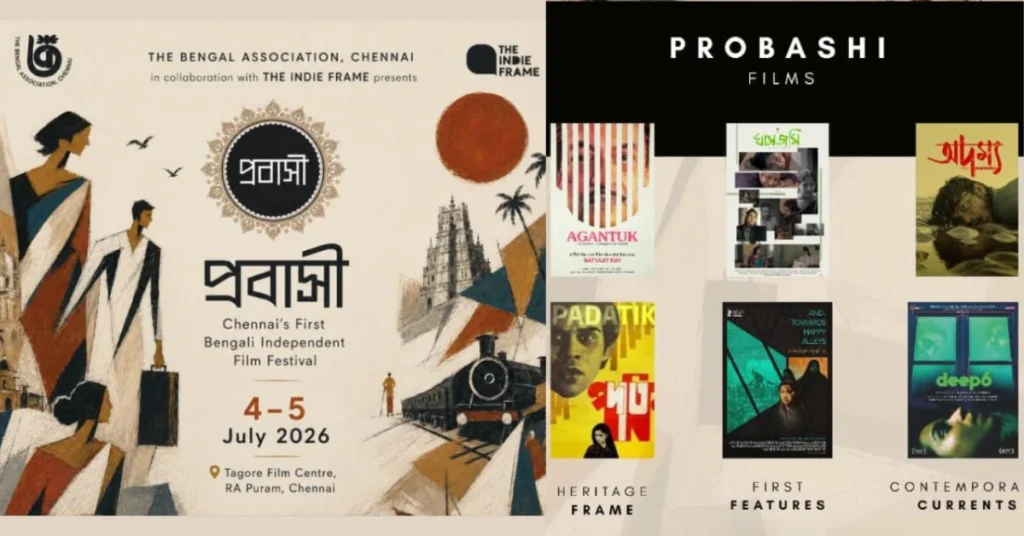
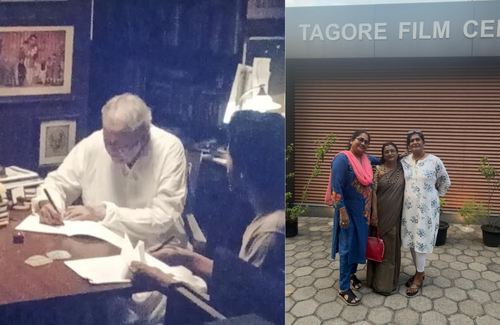
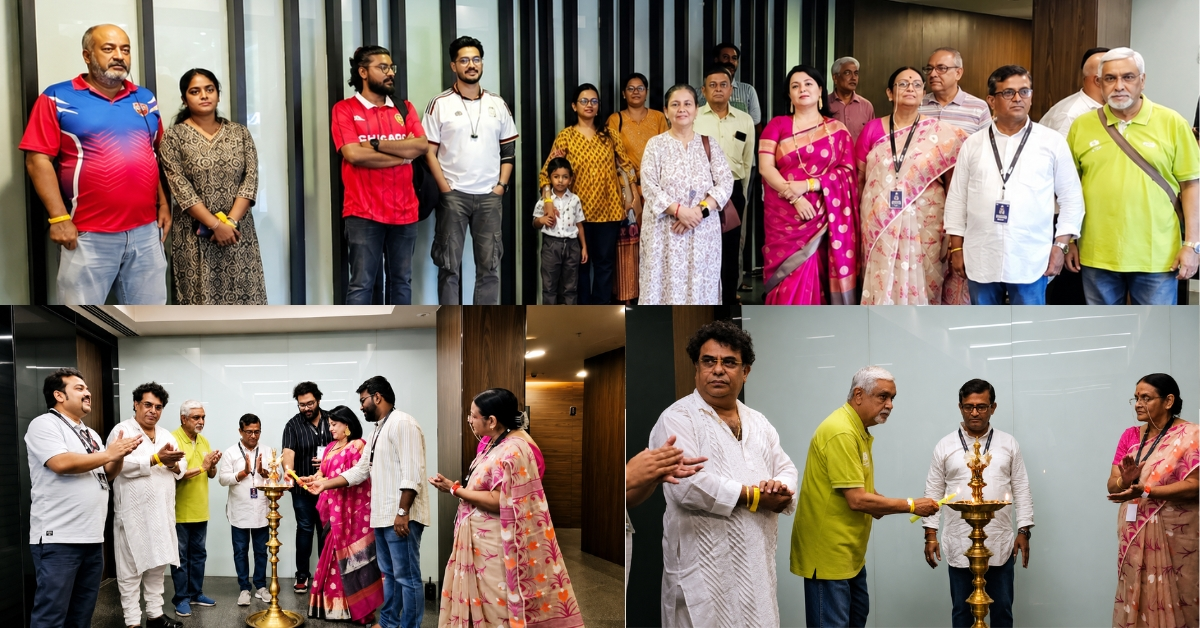
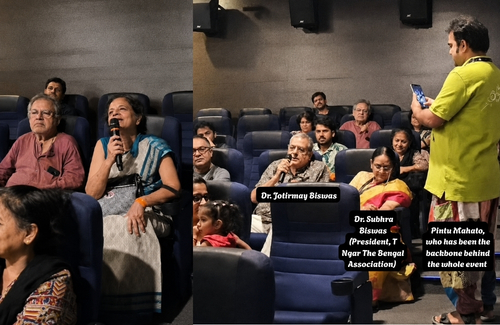
The first Bengali Independent Film Festival commenced in Chennai through a collaboration between The Bengal Association and Indie Frame. Over the last two days, I had the opportunity to watch six films, but what made the experience truly memorable was the incredible range of Bengali cinema that unfolded before me.
The opening film on the first day was Satyajit Ray’s Agantuk, followed the next morning by Mrinal Sen’s Padatik. Later, among the contemporary independent films screened at the festival, Deep6 left me with perhaps the most mixed yet thought-provoking experience.
In just two days, it felt as though I had travelled through different eras and philosophies of Bengali cinema.
On one side stood Satyajit Ray. On the other, Mrinal Sen. And somewhere between them, contemporary filmmakers searching for new cinematic languages while grappling with the complexities of modern storytelling.
Watching Agantuk, I was reminded that Satyajit Ray’s cinema is deeply rooted in understanding people. He explores what individuals think, why they think the way they do, their doubts, their joys, and their vulnerabilities. His films rarely rely on dramatic outbursts. Instead, the narrative quietly seeps into the viewer’s consciousness, leaving a lasting emotional imprint.
Padatik, however, offered an entirely different experience.
Mrinal Sen seems almost determined to make his audience uncomfortable. His cinema embraces freeze frames, jump cuts, unconventional sound design, and a deliberate rejection of traditional storytelling grammar. Even the performances move away from complete naturalism, adopting a stylised and occasionally theatrical quality. To me, this is not a weakness but his cinematic language. Rather than striving for realism alone, Sen seeks impact. He uses cinema to provoke, question, and challenge.
The contrast becomes even more fascinating when one watches the same actor under both directors. Dhritiman Chatterjee, for instance, is used very differently by Ray and Sen. Ray draws out the individual behind the character, while Sen positions the actor within a larger social and political discourse. One searches for the human being; the other constructs an ideological statement.
Up to this point, the differences remain purely cinematic. But after Padatik ended, another question lingered in my mind.
The 1970s witnessed powerful political movements. Revolutionary slogans echoed through Bengal. Countless young lives were lost. Families were torn apart. Many believed they were helping build a new Bengal.
More than fifty years later, if we shift our gaze from the cinema screen to the realities on the ground, what do we see?
History records significant land reforms, the strengthening of the Panchayati Raj system, and meaningful changes in rural Bengal. These achievements deserve acknowledgment.
Yet history also reminds us that West Bengal, once among India’s leading industrial states, gradually lost much of that position. Factories closed. Employment opportunities diminished. Millions of Bengalis migrated elsewhere in search of work. Governments changed, but many fundamental questions remained unanswered.
That is why the biggest question Padatik left me with was not about the film itself.
It was about reality.
How much of the dream that demanded such enormous sacrifice was ultimately realised?
This is not a question aimed at any one political party. The Congress, the Left Front, and the Trinamool Congress have all shaped different chapters of Bengal’s political journey. The true test of any ideology is not found in slogans or rallies but in the everyday lives of ordinary people. Fifty years later, how much has life truly changed? That, perhaps, is the real report card.
Perhaps that is Padatik‘s greatest strength. It refuses to provide answers. Instead, it leaves us with questions that remain profoundly relevant even today.
Among the contemporary films showcased at the festival, Deep6 stood out for entirely different reasons.
Deep6 is an introspective Bengali independent film that explores themes of memory, isolation, emotional trauma, and the fragile complexities of human relationships. Rather than following a conventional narrative, it unfolds through mood, symbolism, and striking visual compositions. It is a film that asks its audience to immerse themselves in its atmosphere as much as in its story.
I wouldn’t call it a bad film. Quite the contrary—there is much to admire.
The cinematography is exceptional. Several frames are so beautifully composed that they remain with you long after the screening ends. Tilottama Shome delivers a nuanced and deeply restrained performance, while the brief appearance of Soumitra Chatterjee lends the film an added emotional resonance.
Yet, despite these strengths, Deep6 left me with mixed feelings.
Many individual scenes are beautifully crafted, but they never fully connect to create a consistently compelling narrative. Time and again, I found myself expecting the story to reach a significant emotional or dramatic breakthrough, but it remained just out of reach.
It feels as though the director had many compelling ideas, none of them lacking merit. However, trying to accommodate them all within a single film makes the narrative feel overstretched. The film spends so much time contemplating its ideas that it occasionally forgets to move forward.
In my opinion, Deep6 would have emerged as a much stronger film had it concluded within ninety minutes. A tighter edit could have sharpened its emotional impact without compromising its artistic vision.
Its greatest strengths lie in its atmosphere, cinematography, and performances. Its greatest weakness is pacing. After a certain point, the narrative begins to circle the same emotional terrain rather than discovering new ground.
Walking out of the festival, I realised that these three films—Agantuk, Padatik, and Deep6—represent three different moments in the evolution of Bengali cinema.
Also Read: Maha Kumbabishekam at Madras Kali Bari: A Sacred Renewal of Faith, Memory, and Devotion
Ray reminds us to look inward, to understand the individual. Sen urges us to question society and history. Deep6, meanwhile, reflects the anxieties of contemporary independent cinema—ambitious, visually rich, emotionally searching, yet still negotiating the balance between artistic expression and narrative discipline.
That, perhaps, is the true beauty of a film festival. It is not merely about watching films. It is about witnessing conversations across generations, discovering how cinematic language evolves, and recognising that while styles may change, the greatest films continue to ask timeless questions about people, society, and the world we inhabit.