

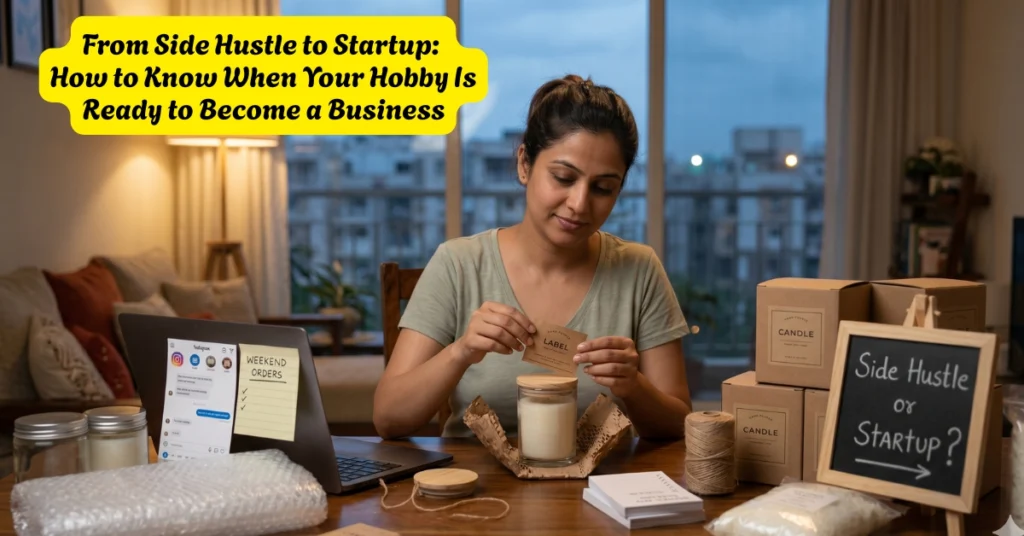
On a quiet Sunday evening, a woman sits at her dining table packing handmade candles. What began as a way to unwind after work has gradually turned into something bigger. Orders arrive through Instagram messages. Friends recommend her products to colleagues. Strangers leave glowing reviews. She finds herself spending more time fulfilling orders than actually making the candles. Then comes the question many creators, crafters, writers, bakers, artists, and wellness practitioners eventually face: Is this still a hobby, or is it becoming a business?
Across India, thousands of people are turning passions into profitable ventures. From home bakers and jewellery makers to content creators and crystal healers, the line between hobby and entrepreneurship has never been thinner. Yet making the leap from side hustle to startup requires more than enthusiasm. It demands clarity, planning, and a realistic assessment of whether the idea can survive in the marketplace.
The Rise of the Passion Economy
The digital era has transformed the way people earn. Social media platforms, e-commerce marketplaces, and online payment systems have made it possible for almost anyone to reach customers without investing heavily in infrastructure.
A decade ago, turning a hobby into a business often required renting space, hiring staff, and spending significantly on marketing. Today, a smartphone and a well-crafted online presence can be enough to test an idea.
This shift has given rise to what many call the “passion economy”—an environment where individuals monetize skills, knowledge, creativity, and personal interests. However, not every successful hobby automatically becomes a sustainable business.
The challenge lies in recognizing the right moment to transition.

Sign One: People Are Already Paying You
The clearest signal is often the simplest: customers are willing to pay.
Compliments are encouraging, but purchases are evidence. If people repeatedly buy your products or services without needing constant persuasion, it indicates genuine market demand.
Many aspiring entrepreneurs fall into the trap of believing that positive feedback equals business potential. In reality, willingness to spend money is a far stronger indicator than praise.
Ask yourself:
- Are customers returning for repeat purchases?
- Do referrals generate new business?
- Are people willing to pay your actual price rather than asking for discounts?
If the answer is yes, your hobby may already be proving its commercial value.
Sign Two: Demand Is Outgrowing Your Free Time
A hobby fits comfortably into spare hours. A business begins demanding dedicated time and attention.
When you find yourself consistently declining orders, delaying deliveries, or sacrificing weekends to keep up, demand may be exceeding your current capacity.
This stage often reveals an important truth: the problem is no longer finding customers. The challenge becomes managing growth.
Successful entrepreneurs often describe this phase as a turning point. What once felt like a creative outlet starts requiring systems, schedules, customer service, inventory management, and strategic planning.
That shift can be overwhelming—but it is also a sign that the opportunity is becoming real.
Sign Three: You Understand Who Your Customer Is
Many hobbies are driven by personal enjoyment. Businesses, however, are driven by customer needs.
A photographer who understands exactly who hires them, a baker who knows which products sell best, or a wellness coach who identifies a specific audience has a significant advantage.
If you can clearly answer questions such as:
- Who buys from me?
- Why do they choose me over competitors?
- What problem am I solving?
you are already thinking like a business owner.
The more precisely you understand your audience, the easier it becomes to market, innovate, and scale.
Sign Four: Your Numbers Make Sense
Passion is essential, but profitability keeps a business alive.
Many side hustles appear successful until owners calculate the true costs involved. Raw materials, packaging, shipping, marketing, software subscriptions, and time all carry value.
Before making the leap, assess whether your venture generates consistent profit rather than occasional income.
Ask yourself:
- Am I covering all expenses?
- Is there enough profit margin to grow?
- Could this income eventually support my financial goals?
You do not need a perfect business plan from day one, but you do need a realistic understanding of the economics. A hobby survives on enthusiasm. A business survives on sustainable revenue.
Sign Five: You Are Ready to Treat It Professionally
One of the biggest differences between a hobbyist and an entrepreneur is mindset. A hobby allows flexibility. A business requires commitment. This means maintaining quality standards, meeting deadlines, responding professionally to customers, managing finances, and continuously improving your offerings.
Many talented individuals struggle not because their product lacks potential, but because they are unwilling to embrace the responsibilities that accompany business ownership. The question is not simply whether your hobby can become a business. It is whether you are prepared to become the person who runs that business.
Avoid the Leap Too Soon
While stories of overnight success dominate headlines, most thriving businesses evolve gradually. Quitting a stable income source immediately may not be necessary—or wise. Many successful founders spent months or even years building their ventures alongside regular employment.
A measured transition often provides valuable advantages:
- Reduced financial pressure
- Time to test the market
- Opportunities to refine products
- Greater confidence in long-term viability
Patience is not a sign of hesitation. It is often a sign of strategic thinking.
Also Read: The Rise of the Sheconomy: How Women Are Redefining the Future of Business
The Future Belongs to the Builders
The modern economy rewards creativity in ways previous generations could hardly imagine. What starts as weekend photography, handcrafted jewellery, spiritual coaching, baking, writing, or content creation can evolve into something far larger than its creator initially envisioned.
Yet the journey from side hustle to startup is not defined by passion alone. It is defined by demand, consistency, profitability, and readiness. Perhaps the most important sign that your hobby is ready to become a business is this: you are no longer asking whether people value what you create. You are asking how to build something bigger around it.
And that question marks the beginning of every entrepreneurial journey. For many aspiring founders, success does not start in a boardroom or an investment meeting. It starts at a kitchen table, a spare bedroom, or a corner of a living room—where a simple hobby quietly grows into a vision worth pursuing.