

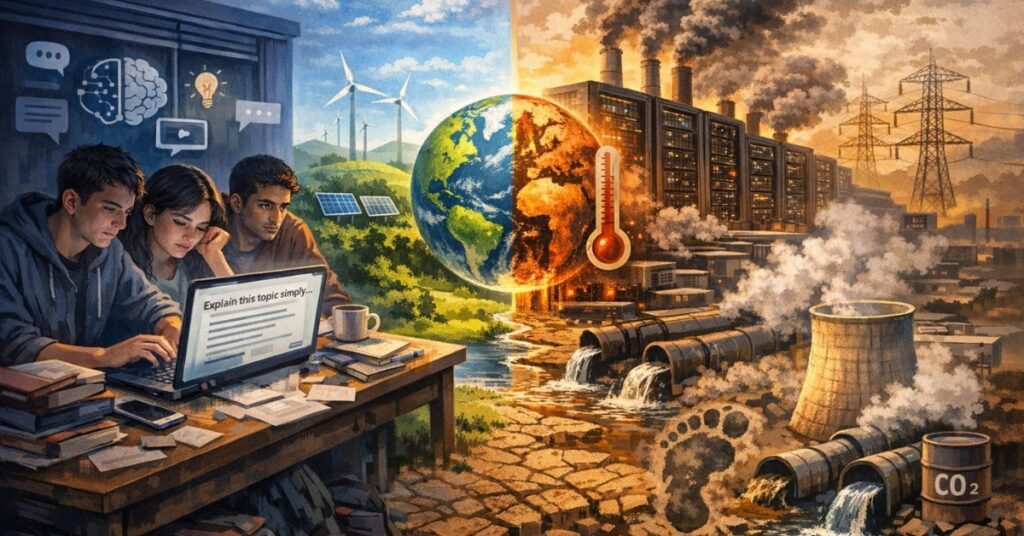
At 2 a.m., a night before our exam, eyes stinging under the harsh glare of a laptop screen, my friends and I type a familiar command into an AI chatbot: “Explain this topic simply.” Within seconds, neatly structured paragraphs appear; clear, confident, and ready to be edited and memorised. No scattered notebooks, no endless Google tabs, no waiting in sight. Just speed,desperation and answers.
For Gen-Z, artificial intelligence has quietly become a devout study partner, planner, editor, and sometimes even a replacement for effort itself. From summarising academic readings to generating creative ideas, AI tools are now embedded in everyday student life. Yet while conversations around AI celebrate convenience and innovation, a crucial question often goes unasked— what does this convenience cost the environment?
As AI usage rises sharply among young users, its environmental footprint that includes everything from energy consumption, carbon emissions, to water use remains largely invisible. This growing dependence in turn raises concerns not only about learning and creativity, but also about sustainability in a world that is becoming increasingly digital with every passing day.
Nineteen-year old Aryan Arun Sharma, a student at CHRIST (Deemed to be University), says AI has become central to his academic routine. “I use ChatGPT most of the time for my projects and assignments. It’s faster and helps me understand topics better,” he explains.
Like many students, while Aryan uses Google for basic searches, he ends up relying on AI to understand concepts, collect data, and structure documents. “It’s even helped me make personal plans and diets, which is tough to find directly on Google,” he adds.
Across borders, the story is similar. Ankit S. Bangre, another nineteen-year old design student at Drexel University in the United States, says AI tools help him survive academic pressure. “It helps me manage readings, assignments, and idea development when my workload gets heavy,” he says. This reliance reflects a broader shift in how Gen-Z accesses knowledge. They prioritise speed, efficiency, and instant clarity.
“Gen-Z’s reliance on AI reflects changing knowledge practices shaped by accessibility rather than laziness,” explains Dr. Krishnapriya T.K., Assistant Professor, Department of Media Studies, CHRIST (Deemed to be University). “The concern lies in reduced awareness of how information is produced and validated.”
AI can support learning, but it can also in turn replace thinking.
“AI enhances learning when used as a support tool,” Dr. Krishnapriya notes. “But it undermines critical thinking when it replaces cognitive effort. The issue is less the technology and more the culture of efficiency around it.”
Aryan agrees. “Using AI for everything is making people less creative. Real-life experiences and emotions can be better than any AI answer,” he says. Yet convenience often wins, especially when deadlines loom and panic strikes.
What powers AI
To understand AI’s environmental impact, it helps to move past the screen and look at what powers it.
AI does not exist in the cloud in a harmless, abstract way. Every AI tool runs on data centres. Huge buildings filled with thousands of servers that operate 24/7 and these servers in turn require massive amounts of electricity to function and large volumes of water to prevent overheating.
According to the International Energy Agency (IEA), data centres already consume over 1% of global electricity, and this demand is expected to rise sharply as AI use increases. Unlike a Google search, which retrieves existing information, AI systems process, predict, and generate responses, making them far more energy intensive.
Research from the University of Massachusetts Amherst found that training a single large AI model can emit as much carbon dioxide as five cars over their entire lifetimes. While individual users may not notice this impact, millions of daily AI queries add up.
Another academic analysis finds that global energy demands from AI computing could nearly double by the end of the decade, largely due to data centre growth, and that inefficient cooling and power systems significantly amplify this environmental footprint. An often overlooked factor is water usage. Data centres use water for cooling, often drawing from local freshwater sources. In water-stressed regions, this worsens existing environmental pressure; an issue that is particularly relevant for countries like India.
In short, every “quick answer” that we seek for comes with a hidden cost: electricity generated (often from fossil fuels), water consumed, and carbon released into the atmosphere.
Aakash Nagraj, who works at Tessact AI, a company that automates video editing and workflow tasks at scale, explains how environmental impact grows with usage. “When AI systems operate at scale, everything becomes about reliability, speed, and cost,” he says. “Even small inefficiencies become expensive.”
User expectations drive this expansion. “People expect instant results,” Aakash explains. “That usually means more computing power and stronger infrastructure.” This demand translates directly into higher energy consumption. “Yes, running AI at scale has an environmental impact,” he admits. “More usage means more electricity.”
Can Awareness Change Behaviour?
While companies are beginning to focus on efficiency by using smaller models and better hardware, the overall demand still continues to rise as AI becomes mainstream. Despite these impacts, AI is often framed as “clean” because it lacks visible pollution.
“Digital technologies are seen as immaterial,” says Dr. Krishnapriya. “Media and industry narratives externalise ecological costs.” Most AI coverage celebrates innovation, speed, and future possibilities. “Current narratives prioritise progress over responsibility,” she adds. “Responsibility complicates success stories.” As a result, environmental costs continue to remain buried under what Aakash terms as “techno optimism”.
Many students admit they were unaware of AI’s environmental impact. “I knew AI used energy, but I didn’t realise how much,” says Ankit. “Knowing this definitely makes me want to use it more intentionally.” Aryan echoes this concern. “AI isn’t bad by itself, but exploiting it without limits could be dangerous in the future.”
According to India’s Ministry of Electronics and Information Technology, the country’s data centre capacity is expanding rapidly to meet digital demand and yet environmental disclosures remain limited.
On the bright side, industry insiders do believe change is possible. “A lot of companies are now focusing on efficiency,” says Aakash. “Smaller models, optimised systems, and cleaner energy can reduce impact.”
This aligns with SDG 12 (Responsible Consumption) and SDG 13 (Climate Action), which call for sustainable technology use. “Journalists have a responsibility to make AI’s ecological costs understandable,” says Dr. Krishnapriya. “When people understand consequences, they make better choices.”
Universities, she argues, should integrate ethical and sustainable technology discussions into classrooms, not as restrictions, but as awareness-building.
Rethinking Convenience
For Gen-Z, AI is not going away. But how it is used can change.
“Mindful use matters,” Dr. Krishnapriya concludes. “Small choices like using AI only when necessary and relying on human creativity can add up.”
As students continue typing prompts late into the night, using AI as their therapist, professor, friend and everything in between, the question is no longer whether AI is helpful, but whether convenience is worth its invisible environmental cost.